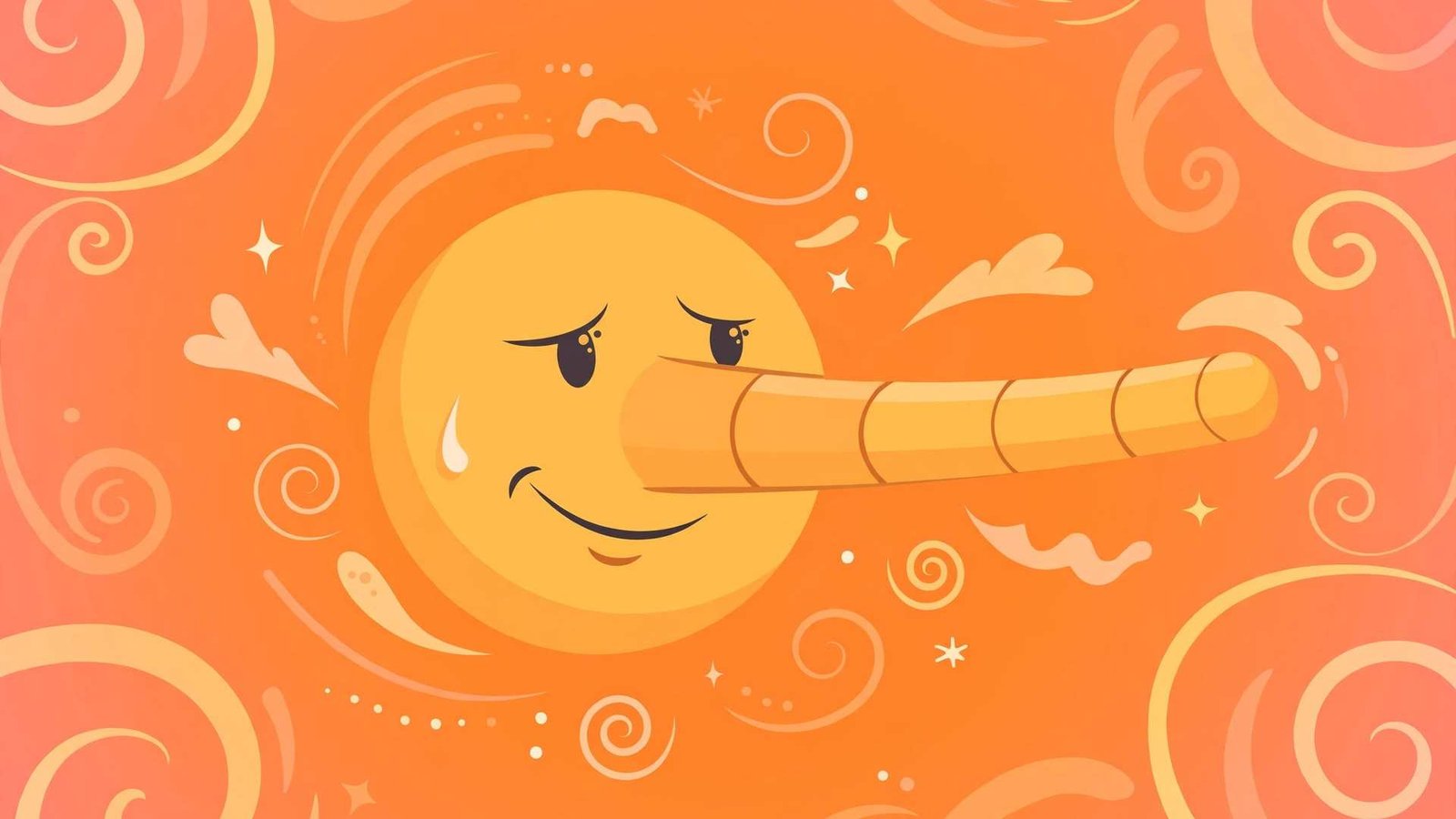
You just got a message that says, “I didn’t eat your fries 🤥.” The little yellow face has a long nose growing from it, and you cannot stop smiling. Is your friend really lying, or just teasing you? The liar emoji makes the joke obvious. It turns a fake excuse into a funny confession.
The symbol shows a smiling face with a long, pointed nose, just like Pinocchio’s. People use it to admit a fib, joke about telling a white lie, tease a friend, or confess something playful. Its emoji meaning is almost always light and silly, never mean or serious.
This guide explains the liar emoji meaning in texts and on social apps. You will also find emoji combinations, copy-and-paste options, similar symbols, platform differences, common mistakes, and simple examples.
The key idea is easy: read the words around 🤥 before deciding if it is a joke or a real confession.
What does the liar emoji mean?
The liar emoji 🤥 mainly means a fib, a white lie, or a playful confession. Its official Unicode name is Lying Face, and the long nose is a nod to Pinocchio, whose nose grew when he lied. People add it after a sentence that is obviously not true, or one they are jokingly admitting.
It is rarely used to make a serious accusation. Instead, it softens a joke. For example, “I’m totally not tired 🤥” is funnier than the same sentence without the emoji. The symbol tells the reader not to take the claim seriously.
Common examples include:
- “I had only one cookie 🤥” — a playful fake claim.
- “I totally did my homework 🤥” — an obvious joke.
- “I’m five minutes away 🤥” — teasing about being late.
- “I’m not jealous at all 🤥” — a funny confession.
Different meanings of the liar emoji
General meaning
🤥 stands for a joke, a white lie, or a playful excuse. It fits teasing, fake promises, and funny confessions.
Romantic meaning
In a romantic chat, it can admit feelings in a teasing way. “I didn’t miss you at all 🤥” really means the opposite.
Friendly meaning
Friends use 🤥 to tease each other or confess small silly things. “I would never prank you 🤥” is clearly a joke between friends.
Funny meaning
It is one of the funniest emojis for fake excuses: “I’m running late because of traffic 🤥” when you overslept.
Sarcastic meaning
The long nose can add sarcasm to a comment. “Yeah, I love Mondays 🤥” says the opposite in a funny tone.
Social media meaning
On social media, 🤥 marks jokes about New Year’s resolutions, diets, bad habits, and funny lies. It is a popular symbol for confession memes.
Text message meaning
In texts, it usually follows an obvious fib or a joke you are pretending to believe. Food talk, lateness, and excuses are common themes.
Workplace meaning
At work, 🤥 fits only casual chats, like joking about the printer “working fine.” Keep it out of formal messages.
When should you use the liar emoji?
Use 🤥 when you want to joke about a fib or make a playful confession. Good situations include:
- Teasing a friend: “I would never eat your snacks 🤥”
- Admitting a habit: “I’m quitting sugar starting tomorrow 🤥”
- Joking about lateness: “Leaving home in five minutes 🤥”
- Fake modesty: “I’m not competitive at all 🤥”
- Joking about jealousy: “I’m totally fine with it 🤥”
- Excuses: “My dog ate my notes 🤥”
- Flirty teasing: “I didn’t check your profile 🤥”
- Posting a confession meme: “Me: I’ll sleep early. Also me at 3 a.m. 🤥”
Avoid using it in serious conversations. The liar emoji is for fun, not for real accusations or honest apologies.
What does the liar emoji mean from a girl?
From a girl, 🤥 often means playful teasing or a joke confession. “I’m not mad at all 🤥” is usually a funny hint that she noticed something.
In a flirty chat, it may hide true feelings in a cute way: “I didn’t think about you today 🤥.” Look at her words and tone rather than gender alone.
What does the liar emoji mean from a boy?
From a boy, 🤥 can mean a joke, a tease, or a playful fake excuse. “I finished the whole pizza myself? No 🤥” is clearly humor.
Beside 😂 or 😏, it is almost always a joke. In a serious talk, it might flag something he is dodging, but context matters more than gender.
Liar emoji on Snapchat
On Snapchat, 🤥 fits funny snaps, confession stories, and memes about diets or bad habits. It works well with silly face filters.
It is not a standard Snapchat friendship-status symbol. Read a private use from the snap, caption, and your usual tone.
Liar emoji on WhatsApp
Among WhatsApp emojis, 🤥 fits group chats, teasing friends, and joking excuses. “Traffic was chaotic today 🤥” is a classic.
The design may differ from other apps, but its basic meaning stays the same.
Liar emoji on Instagram
Instagram emojis create a visual mood. 🤥 fits funny captions, meme posts, confession stories, and diet jokes: “New me starts Monday 🤥.”
In comments, it can tease a friend’s claim or join a joke. One symbol is usually humor, not a serious callout.
Liar emoji on TikTok
TikTok emojis change with trends, but 🤥 often marks confession videos, fake excuse skits, and “me vs. me” memes.
A trend can add an inside meaning. Check the audio, caption, hashtags, and comments before assuming a fixed message.
Emoji combinations
Emoji combinations make the liar emoji funnier and more specific. Here are easy ways to use it:
| Emoji combination | Meaning |
|---|---|
| 🤥😂 | A funny lie |
| 🤥😏 | A cheeky fib |
| 🤥🙈 | Hiding a confession |
| 🤥🤞 | Crossing fingers on a promise |
| 🤥🤷 | “Who, me?” denial |
| 🤥🍪 | “I didn’t eat the cookies” |
| 🤥⏰ | Joking about being late |
| 🤥💤 | Pretending not to be sleepy |
| 🤥🐶 | The dog-ate-my-homework excuse |
| 🤥😅 | A sheepish fake excuse |
| 🤥🎭 | Dramatic play-acting |
| 🤥📱 | “I wasn’t on my phone” |
| 🤥🍕 | Denying the last slice |
| 🤥💪 | Fake fitness promise |
| 🤥🤫 | A secret fib |
| 🤥😬 | Caught in a white lie |
| 🤥🙄 | Sarcastic fake agreement |
| 🤥💘 | A flirty little fib |
Copy and paste liar emoji
Tap or select the symbol you want, then copy it into a text, caption, bio, or comment.
- `🤥` Copy
- `🤥🤥` Copy
- `🤥😂` Copy
- `🤥😏` Copy
- `🤥🙈` Copy
- `I totally did my homework 🤥` Copy
- `Leaving in five minutes 🤥` Copy
- `I’m not jealous at all 🤥` Copy
This copy and paste emoji is the Unicode character U+1F925. The receiving device draws its own version of the same character.
Similar emojis
| Emoji | Name | Meaning | Difference |
|---|---|---|---|
| 🤥 | Lying Face | A playful fib | The long-nose original |
| 😏 | Smirking Face | Smug, flirty teasing | No lie implied |
| 😬 | Grimacing Face | Awkward, caught | Embarrassed reaction |
| 🙈 | See-No-Evil Monkey | Pretending not to see | Shy or hiding |
| 🤫 | Shushing Face | Secret, quiet | Asking for silence |
| 🤭 | Giggling Face | Holding back a laugh | Secret amusement |
| 😅 | Grinning with Sweat | Nervous laugh | Relief, not a fib |
| 🤥 | Lying Face | Confession joke | Repeated for emphasis |
| 😜 | Winking with Tongue | Playful teasing | Silly, not fake |
| 🤐 | Zipper-Mouth Face | Keeping quiet | No comment, not a lie |
| 🫣 | Face with Peeking Eye | Sneaky watching | Shy peek, not a fib |
| 🃏 | Joker | Trick, prank | A playing card, not a face |
Emoji appearance across platforms
Unicode defines the character, but each company draws its own artwork. The nose length, angle, expression, and colors can change.
- Apple: A smiling yellow face with a long pointed nose extending to the left, shaded for depth.
- Android/Google: A cheerful face with a smooth, rounded long nose in Google’s style.
- Samsung: The same lying-face idea in Samsung’s illustration style; updates may alter details.
- Windows/Microsoft: Often uses stronger outlines and flatter shapes than mobile designs.
- Facebook: Uses custom artwork that has changed across versions, with its own nose shape.
- WhatsApp: Uses its own lying-face artwork, with small color and shading differences.
The code remains U+1F925 on every platform. If design details matter, compare the current versions on the actual devices.
Fun facts
- Its official Unicode name is Lying Face. The symbol’s code point is U+1F925.
- It has been in Unicode since version 9.0. That version was released in 2016.
- It joined Emoji 3.0 in 2016. This helped standardize its use as an emoji character.
- The long nose comes from Pinocchio. In the classic story, his nose grew every time he told a lie.
- It is almost always playful. People use it for jokes and white lies, not serious accusations.
- It is a meme favorite. Confession memes and fake excuse jokes often feature the lying face.
- Its artwork is not universal. Platforms draw the same character with different nose shapes and expressions.
- It works without words. A single 🤥 after a sentence is enough to flag it as a joke.
Common mistakes
Taking it as a real accusation: 🤥 usually signals a joke or white lie, not a serious claim that someone is lying.
Using it to call someone out: Sending a lying face during a real argument can feel mocking. Use clear words instead.
Ignoring the joke tone: The emoji tells the reader not to take the sentence literally. Read the humor first.
Confusing it with 😏: 😏 is a smug smirk, while 🤥 specifically points to a fib with its long nose.
Expecting the same design everywhere: Apple, Android, Samsung, Windows, Facebook, and WhatsApp can draw the nose differently. A shape change does not create a new emoji meaning.
Using it in serious messages: A playful fib symbol may feel wrong in formal, urgent, or sensitive conversations. Use clear language when the stakes are high.
FAQs:
What does the liar emoji mean in texting?
In texting, 🤥 most often means a joke fib, a white lie, or a playful confession. It follows a sentence that is obviously not true. Read the nearby words first. A teasing message is likely humor, while a sincere talk needs no emoji to be honest.
What is the official name of the liar emoji?
The official Unicode name is Lying Face, with the code point U+1F925. People call it the liar emoji because of its long Pinocchio-style nose, which clearly signals a fib. It was added in Unicode 9.0 in 2016 and joined Emoji 3.0 the very same year.
Is the liar emoji rude?
The liar emoji is not rude on its own. It is playful and usually signals a joke. It can feel mocking if you send it during a real argument to call someone a liar. In friendly chats, memes, and teasing, it is harmless and fun.
What does 🤥 mean on social media?
On social media, 🤥 often supports confession memes, fake excuse jokes, diet jokes, and funny lies. Instagram emojis and TikTok emojis gain meaning from the photo, video, audio, hashtags, and comments around them. One symbol is usually humor, not a serious accusation.
Can I use the liar emoji at work?
Yes, in casual workplace chats. It works for joking about the printer, meetings running late, or Monday motivation. For example, “Caffeine has no effect on me 🤥” is clear humor. Skip it in formal reports, difficult feedback, or serious messages.
Why does the liar emoji look different on my phone?
Your phone or app draws the Unicode character using its own emoji artwork. Apple, Google, Samsung, Microsoft, Facebook, and WhatsApp can choose different nose shapes, angles, and shading. You are still sending the same U+1F925 character, so its basic identity remains the lying face.
What does 🤥 mean from a crush?
From a crush, 🤥 often hides true feelings in a playful way. “I didn’t think about you today 🤥” usually means the opposite. It keeps the mood light while hinting at the truth. Check the flirty tone and your history together before reading too much into one symbol.
How do I copy and paste the liar emoji?
Select this symbol: 🤥. Choose Copy, tap where you want it, and choose Paste. You can use it in texts, captions, comments, profiles, and documents that support emoji. If it appears as an empty box, the device or font may lack proper support.
Conclusion:
The liar emoji 🤥 can mean a playful fib, a white lie, a fake excuse, or a funny confession. Its text meaning depends on the words, relationship, platform, and tone.
Use 🤥 for jokes, teasing, memes, light flirting, and confession posts. Pair it with other emoji combinations for clarity.
In serious conversations, choose plain words. With the right context, the liar emoji turns a fake claim into a shared laugh.

I’m Ava Richardson, a passionate writer and author at Outrexora.com, where I share engaging, informative, and easy-to-understand content on the latest news, insights, and trends. My goal is to bring readers useful information in a clear and enjoyable way.