Happy Sad Emoji 🎭: Meaning, Copy and Paste Combos, and Smart Uses (2026)
You just passed the exam, but your best friend did not. You are smiling at the result on your phone, yet your chest feels heavy.
No single word fits that feeling. That exact moment happy and sad at the same time is where the happy sad emoji comes in.
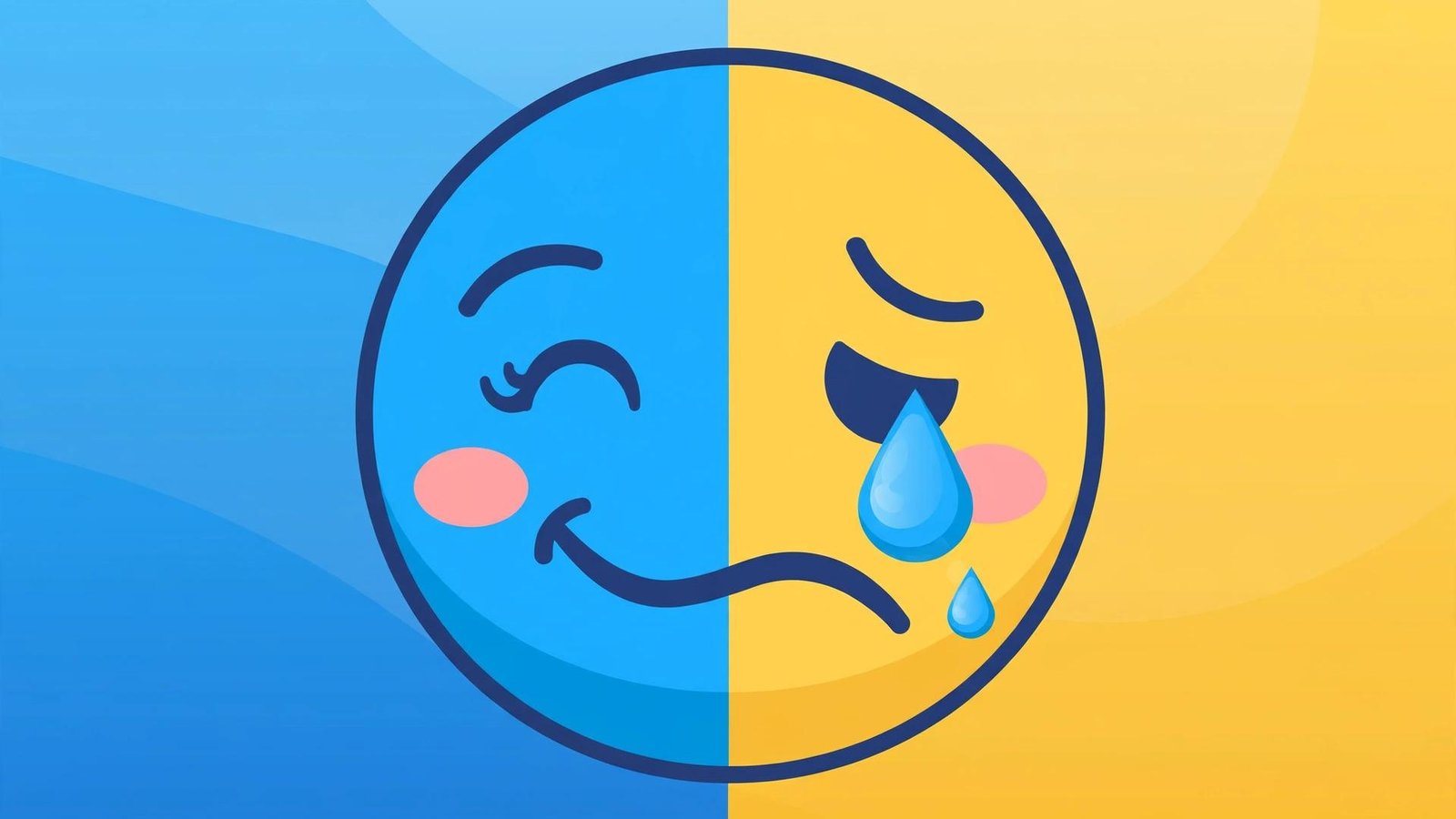
Here is the honest truth first: there is no single official happy sad emoji in Unicode. No one character shows a happy face and a sad face together.
Instead, people use 🎭, the pair of theater masks, or combine symbols like 🙂 with 😢. In this guide, 🎭 is the closest single representation of the happy sad emoji meaning.
This guide explains the main happy sad emoji meanings in texts and on social apps.
You will find romantic, friendly, funny, and sarcastic uses, emoji combinations, copy-and-paste lines, similar symbols, platform differences, and texting examples. The key idea is simple: 🎭 stands for feelings that are not purely happy or purely sad.
What does the happy sad emoji mean?
The happy sad emoji 🎭 mainly means mixed feelings happiness and sadness at the same time. It captures bittersweet moments: graduations, farewells, moving away, finishing a good book, or a happy ending that still stings.
It can also describe a person or situation that feels two-sided. For example, “I loved the trip but I am exhausted 🎭” mixes joy with tiredness. The theater masks one smiling, one frowning show the mixed message at a glance.
Common examples include:
- “Got the job! Will miss this team though 🎭” — excitement plus sadness.
- “Last day of school 🎭” — happy and nostalgic.
- “Proud of you, but I will miss you 🎭” — bittersweet support.
Different meanings of the happy sad emoji
General meaning
🎭 stands for bittersweet feelings: happy and sad together. It fits graduations, goodbyes, endings, new beginnings, and moments that pull your heart in two directions.
Romantic meaning
In a romantic chat, it can mean “I am happy with you, but something hurts.” For example, “I loved tonight, I just miss you already 🎭.”
Friendly meaning
Friends use 🎭 for warm but wistful messages. “Had the best time with you 🎭” says the visit was wonderful and sad it is over.
Funny meaning
It can joke about small mixed feelings: “The weekend is over and I survived Monday 🎭.” The humor comes from feeling two things at once.
Sarcastic meaning
🎭 can add a fake grin to a complaint: “Oh great, another meeting 🎭.” The smiling mask says one thing while the words say another.
Social media meaning
On social media, 🎭 labels bittersweet captions: flashback photos, farewell posts, season finales, and graduation pictures. It tells readers the mood is complicated.
Text message meaning
In texts, it usually signals a bittersweet update. “I am moving next week 🎭” means the news is good but leaving is hard.
Workplace meaning
At work, 🎭 fits farewells and transitions: “Last day at the company 🎭.” Keep it in casual team chats, not serious announcements.
When should you use the happy sad emoji?
Use 🎭 when one feeling is not enough to describe the moment.
- Saying goodbye: “Going to miss you so much 🎭”
- Sharing bittersweet news: “We sold the house 🎭”
- Celebrating an ending: “Last exam done! 🎭”
- Posting nostalgic content: “One year ago today 🎭”
- Congratulating through tears: “So proud of you 🎭😢”
- Marking a new start: “First day at the new job 🎭”
- Reacting to mixed news: “Happy for her, sad for me 🎭”
Avoid using it when the moment is purely joyful or purely tragic. A party photo may need just 🎉, and real grief deserves plain, caring words.
What does the happy sad emoji mean from a girl?
From a girl, 🎭 often means genuine mixed emotions: “I had the best birthday, now I am emotional 🎭.” It shows she feels close to you and trusts you with a complicated feeling.
In a romantic chat, it may mean “I am happy with you but miss you,” especially beside 💕 or 🥲. Her words and your relationship matter more than the emoji alone.
What does the happy sad emoji mean from a boy?
From a boy, 🎭 can mean pride mixed with sadness: “Made the team, but I am leaving my friends 🎭.” It often softens an emotional message he does not want to spell out fully.
Beside 🙂, 🥲, or a heartfelt sentence, it likely shows real bittersweet feeling rather than a joke. In a casual group chat, it may simply react to mixed news.
Happy sad emoji on Snapchat
On Snapchat, 🎭 fits snaps about endings and beginnings: last-day-of-school selfies, moving-day boxes, and season-finale reactions. It adds a thoughtful tone to an otherwise funny snap. It is not a standard Snapchat friendship-status symbol.
Happy sad emoji on WhatsApp
Among WhatsApp emojis, 🎭 fits family news, farewells, and life updates. “So happy for you 🎭” shows pride with a hint of wistfulness.
Happy sad emoji on Instagram
Instagram emojis set the mood of a post. 🎭 fits graduation photos, throwback posts, farewell carousels, and honest captions: “End of an era 🎭✨.” In comments, it can mean “I feel this” for bittersweet content.
Happy sad emoji on TikTok
TikTok emojis shift with trends, but 🎭 often appears in bittersweet edits, graduation videos, goodbye montages, and nostalgic audios. It signals the video will make viewers smile and ache at once. Check the audio, caption, and comments before assuming a fixed meaning.
Emoji combinations
Emoji combinations make the happy sad emoji more specific:
| Emoji combination | Meaning |
|---|---|
| 🎭❤️ | Bittersweet love |
| 🎭😢 | Happy yet crying |
| 🎭😊 | Smiling through sadness |
| 🎭🥲 | Tearful happiness |
| 🎭💔 | Love with heartbreak |
| 🎭✨ | Magical but wistful |
| 🎭🎓 | Graduation feelings |
| 🎭✈️ | Excited but leaving |
| 🎭💍 | Happy-sad engagement news |
| 🎭🎬 | End of a favorite show |
| 🎭🎂 | Birthday nostalgia |
| 🎭🤗 | Comforting mixed feelings |
| 🎭🌅 | New beginning, old ending |
| 🎭🎶 | Emotional song moment |
| 🎭📖 | Finished a beloved book |
| 🎭👶 | Proud parent emotions |
| 🎭🍷 | Toast with mixed feelings |
| 🎭😂 | Laughing through it |
Copy and paste happy sad emoji
Select the symbol, then copy it into a text, caption, bio, or comment.
- 🎭 Copy
- 🎭🎭 Copy
- 🎭❤️ Copy
- 🎭😢 Copy
- 🎭🥲✨ Copy
- 🎓🎭✈️ Copy
- Going to miss you 🎭 Copy
- End of an era 🎭 Copy
This copy and paste emoji is the Unicode character U+1F3AD. Each device draws its own version.
Similar emojis
| Emoji | Name | Meaning | Difference |
|---|---|---|---|
| 🥲 | Smiling face with tear | Happy but emotional | A face, more personal |
| 🙂 | Slightly smiling face | Polite or subtle smile | Single, mild emotion |
| 😊 | Smiling face with smiling eyes | Warm happiness | Pure joy, no sadness |
| 😢 | Crying face | Sadness, tears | Pure sadness, no joy |
| 😭 | Loudly crying face | Strong crying | Intense grief |
| 😔 | Pensive face | Thoughtful sadness | Quiet regret |
| 😅 | Grinning face with sweat | Nervous relief | Relief, not bittersweet |
| 😬 | Grimacing face | Awkwardness | Discomfort, not nostalgia |
| 😌 | Relieved face | Calm contentment | Peaceful, single mood |
| 💔 | Broken heart | Heartbreak | Romance-focused pain |
| 🤔 | Thinking face | Considering | Thought, not feeling |
| 🎬 | Clapper board | Movies, endings | An event, not an emotion |
Emoji appearance across platforms
Each company draws the same character with its own artwork. Mask shapes, colors, and style can change.
- Apple: Two detailed theater masks, one smiling and one frowning, with rich shading.
- Android/Google: Stylized masks in Google’s rounded design language with bold colors.
- Samsung: The same mask pair in Samsung’s illustration style; updates may alter details.
- Windows/Microsoft: Often uses stronger outlines and flatter shapes than mobile designs.
- Facebook: Uses custom artwork that has changed across versions.
- WhatsApp: Uses its own mask artwork, with small color and expression differences.
Fun facts
- No single official happy sad emoji exists. Unicode has no character combining a happy face and a sad face, so 🎭 is the closest single symbol.
- Its official Unicode name is Performing Arts. The symbol’s code point is U+1F3AD.
- It has been in Unicode since version 6.0, released in 2010, and joined Emoji 1.0 in 2015.
- The masks come from ancient Greek theater. Smiling and frowning masks are about 2,500 years old and stood for comedy and tragedy.
- The masks are linked to two muses. Thalia represented comedy, and Melpomene represented tragedy in Greek mythology.
- People also pair faces instead. 🙂😢 and 🥲 are common texting alternatives for the same mixed feeling.
- Its meaning shifts with context. The same 🎭 can mark a graduation, a breakup, or a theater night depending on the words around it.
- Artwork differs by platform, but the masks always read as one smiling and one frowning.
Common mistakes
Assuming 🎭 always means theater: Its official theme is performing arts, but most people use it for bittersweet feelings. Check the message first.
Using it for pure sadness: If the moment is only sad, 😢 or kind words fit better. 🎭 implies some happiness too.
Using it for pure celebration: A big win with no downside reads better with 🎉 or 🥳. Adding 🎭 can confuse the mood.
Reading too much into the sender’s gender: The meaning does not change automatically with a girl or boy. Conversation and relationship matter more.
Treating it as an official “happy sad” emoji: No such official character exists. People use 🎭, 🙂😢, or 🥲, so stay flexible.
Ignoring sarcasm: The smiling mask can hide a complaint. “Love Mondays 🎭” is probably not sincere.
How to Reply When Someone Sends You the Happy Sad Emoji
A lone happy sad emoji with no words around it can mean several things, so the safest reply starts from the messages just before it. Read the last few lines, decide whether the mood is serious, playful, or somewhere in between, and then answer that mood rather than the symbol alone.
Match the energy: if the chat has been light, keep your reply light too. A short reaction in the same tone tells the sender you understood them without making the moment bigger than it is.
Name the feeling: putting the emotion into words, kindly and without guessing too hard, works in almost every case. It shows you paid attention and gives the sender an easy way to confirm or correct you.
Ask one short question: when the tone is genuinely unclear, a simple check in question beats a wrong assumption. It keeps the conversation moving and avoids an awkward misread.
Send one back, with words: returning the same emoji plus one real sentence is the warmest option of all. The emoji mirrors their feeling, and the sentence makes sure your meaning cannot be missed.
FAQs:
What does the happy sad emoji mean in texting?
In texting, the happy sad emoji 🎭 means mixed feelings happy and sad at the same time. It fits bittersweet updates like “Got the job, leaving my friends 🎭.” There is no single official happy sad emoji, so people use 🎭, 🙂😢, or 🥲. Always read the nearby words to catch the exact mood.
Is there a real happy sad emoji?
No, there is no official emoji that combines a happy face and a sad face in one character. The closest single symbol is 🎭, the theater masks, because one mask smiles and the other frowns. Many people instead pair 🙂 with 😢, or use 🥲, the smiling face with a tear.
What does 🎭 mean on social media?
On social media, 🎭 usually signals a bittersweet mood in the caption or comments. Instagram emojis like 🎭 appear on graduation posts, farewell photos, and throwback content. TikTok emojis follow trends, so check the audio, hashtags, and comments to see whether a video uses it sincerely or as a joke.
What does the happy sad emoji mean from a girl?
From a girl, 🎭 usually means genuine mixed emotions, such as joy mixed with nostalgia or longing. For example, “Best weekend ever 🎭” says it was wonderful and sad that it ended. In romantic chats it can mean happiness with a hint of missing someone. Her words and your relationship give the clearest answer.
What does the happy sad emoji mean from a boy?
From a boy, 🎭 often means pride mixed with sadness, like celebrating a win while missing people. It can also soften an emotional message he prefers not to spell out. In a group chat, it may simply react to mixed news. The surrounding text matters more than gender.
Can I use the happy sad emoji at work?
Yes, in casual workplace chats. It works for farewells, team changes, and project endings, such as “Last day on the project 🎭.” Skip it in formal reports, serious announcements, or sensitive messages where a playful or emotional tone could distract from the point.
Why does the happy sad emoji look different on my phone?
Your phone or app draws the Unicode character using its own emoji artwork. Apple, Google, Samsung, Microsoft, Facebook, and WhatsApp can choose different mask shapes, colors, and styles. You are still sending the same U+1F3AD character, so its basic identity stays the same.
How do I copy and paste the happy sad emoji?
Select this symbol: 🎭. Choose Copy, tap where you want it, and choose Paste. You can use it in texts, captions, comments, profiles, and documents that support emoji. If it appears as an empty box, the device or font may lack proper support.
Why theater masks became the symbol
The masks on 🎭 are about 2,500 years old as a symbol. They come from ancient Greek theater, where actors wore masks to play different roles, and the smiling and frowning pair came to stand for comedy and tragedy. In Greek mythology, two muses carried the idea: Thalia represented comedy, and Melpomene represented tragedy.
That ancient pairing is why the symbol fits mixed feelings so perfectly. One mask smiles while the other weeps, and together they say what one face cannot: life holds both at once. The emoji’s official Unicode name is Performing Arts, codepoint U+1F3AD, added in Unicode 6.0 back in 2010 and joining Emoji 1.0 in 2015.
Most people online have quietly repurposed it. Its official theme is theater, but in chats and captions it almost always means bittersweet emotion. Check the message before assuming someone is talking about a play.
Alternatives when 🎭 is not quite right
Because no official happy sad emoji exists, people built a small family of workarounds. Each one carries a slightly different shade of mixed feeling.
🙃 Upside-down face is the sarcastic cousin. It looks cheerful at first glance, but the flipped position signals irony, hidden frustration, or “smiling, but something is off.” Younger texters use it for the nihilistic, joking side of mixed feelings, while older readers sometimes take it at face value.
🥲 Smiling face with tear is the most personal option. It shows a face that is happy and crying at once, perfect for bittersweet news delivered warmly. It reads more emotional and less theatrical than 🎭.
🙂😢 paired faces spell it out literally: a smile plus tears side by side. Some people prefer this because it leaves no room for confusion. Others find it clunky next to the elegance of 🎭.
😅 Grinning face with sweat covers nervous relief rather than true bittersweetness. Use it when the feeling is “phew, that was close” rather than “happy and sad.”
Happy Sad Emoji for Graduation Day Goodbyes to Classmates
Graduation day is the perfect happy sad moment, because caps fly up while friendships face distance. A message like we did it, class of 2026, going to miss this crew 🎭🎓 captures pride and parting in one line, and classmates reply with their own masks and memories. Keep the message about shared moments, like late study nights and inside jokes, so the goodbye feels warm rather than heavy.
For a group chat goodbye, name one memory per friend if you can. A line like remember our first day nerves, look at us now 🎭 tells each classmate they mattered, and it turns a generic farewell into a keepsake. Avoid long speeches in the group chat, since short and sincere lines get read and remembered, while long ones get skimmed.
After graduation, the happy sad emoji keeps working for reunions and throwbacks. A photo caption like one year later, still my people 🎭✨ says distance did not break the bond, and it invites old classmates to reply. Used with care, the masks honor both the achievement and the ache of leaving, which is exactly what graduation feels like.
Happy Sad Emoji in Farewell Messages to a Moving Friend
When a friend moves away, the happy sad emoji says what plain words struggle to hold: joy for their new chapter plus sadness at the distance. A message like so happy for your new city, sad our coffee walks end here 🎭💛 balances both feelings, and it tells your friend their move is celebrated, not resented. Add one concrete promise, like a video call every Sunday, so the farewell ends with a plan.
Moving farewells work best when they name what you will miss. A line like I will miss our rainy day movie nights, but I cannot wait to visit your new place 🎭🏠 gives the friend a real memory to carry, plus a reason to look forward. Avoid jokes about never seeing them again, since humor about loss can sting when someone is already emotional about leaving.
For a farewell card or caption, pair the emoji with a short wish. A line like new streets, same friendship, cheering for you from here 🎭✈️ closes the message with hope, and the masks remind readers that happy and sad can live side by side. That honest mix is what makes a moving farewell feel true.
Happy Sad Emoji for New Beginnings That Hurt a Little
New beginnings often carry two feelings at once, and this symbol gives that mix a name. Starting a new job, moving to a new city, or beginning a new chapter can feel exciting and sad in the same breath. A message such as new city, same heart with this symbol tells friends that the joy is real and the goodbye is real too. Friends can then respond to both feelings, celebrating the step while honouring what is being left behind.
The power of this symbol is that it refuses to simplify a complex moment. A purely happy symbol would hide the sadness, while a purely sad symbol would hide the hope. The masks together say that life can hold both, and that honesty often brings the warmest replies. People who receive such a message feel trusted, because the sender shared a full feeling rather than a polished version of it.
Happy Sad Emoji for Endings Worth Celebrating
Endings deserve celebration even when they sting, and this symbol fits farewells, final performances, and last days perfectly. A caption such as end of an era, grateful for every moment with the masks tells readers that the ending is both proud and tender. It invites comments that match that tone, with friends sharing memories rather than only saying congratulations or only saying sorry. The result is a richer farewell, where joy and nostalgia sit side by side.
Teachers, coaches, and team leaders can use this symbol to close a chapter with grace. A message to a graduating class or a departing team can thank people for shared effort while admitting that parting is hard. That honesty helps groups move forward, because everyone feels seen in both feelings. An ending framed this way becomes a memory to keep, not just a date to forget.
Frequently Asked Questions About the Happy Sad Emoji
Is there an official happy sad emoji? No. Unicode has no single character that combines a happy face and a sad face. People use the theatre masks, a smiling face with a tear, or a smile beside a crying face to express the same mixed feeling.
When should I avoid using it? Avoid it when the moment is purely joyful or purely tragic. A party photo usually needs a celebration symbol, while real grief deserves plain and caring words without a playful mask.
Does it always mean theatre? No. Its official theme is performing arts, but most people use it for bittersweet feelings. Check the message first, because theatre is rarely the intended meaning in personal chats.
Conclusion:
The happy sad emoji 🎭 stands for feelings that are not purely happy or purely sad. There is no single official character for this idea, so people use 🎭, 🙂😢, or 🥲.
Use 🎭 for goodbyes, graduations, bittersweet news, nostalgic posts, and moments that pull your heart in two directions.
When the mood is only joyful or only sad, pick a simpler symbol. With the right context, the happy sad emoji says what words cannot.
I’m Ava Richardson, a passionate writer and author at Outrexora.com, where I share engaging, informative, and easy-to-understand content on the latest news, insights, and trends. My goal is to bring readers useful information in a clear and enjoyable way.

I’m Ava Richardson, a passionate writer and author at Outrexora.com, where I share engaging, informative, and easy-to-understand content on the latest news, insights, and trends. My goal is to bring readers useful information in a clear and enjoyable way.