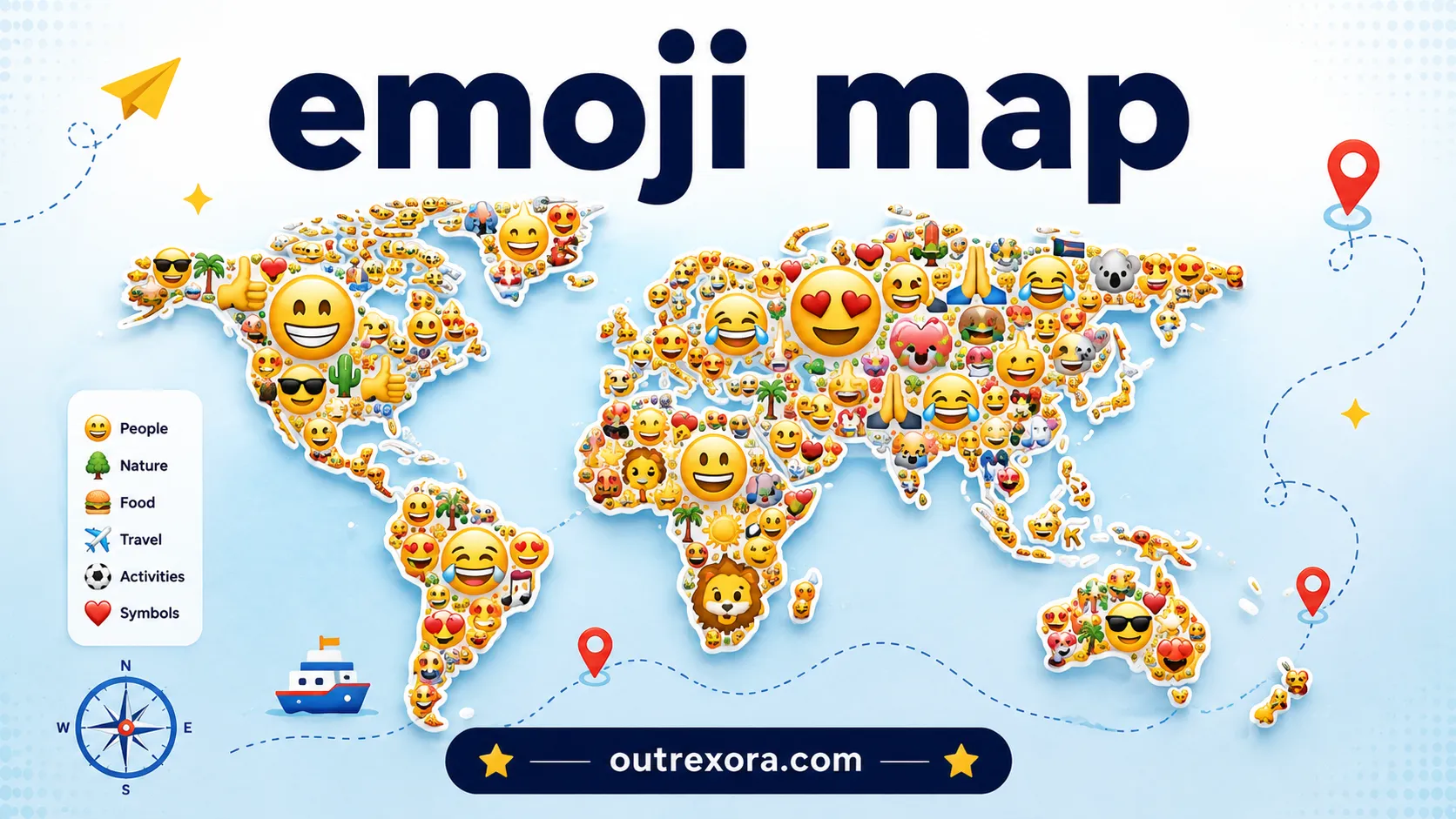
A simple map emoji can turn an ordinary message into a clear visual journey.
I first noticed how useful the emoji map can be when planning a trip in a group chat. Instead of typing a long explanation about places, directions. Or travel plans, a few familiar symbols made the message instantly easier to understand.
From location pins to compass symbols, these emojis can add context without making your message feel crowded.
If you use WhatsApp emojis, Instagram emojis. Or TikTok captions, understanding their context helps you choose the right symbol for every situation.
An emoji map turns locations, journeys, and destinations into quick visual language.
What do emoji map mean?
The emoji map family is useful for talking about places, directions, travel, destinations, and geographic ideas. The exact feeling depends on the surrounding words and platform.
🗺️ is the most direct map symbol. It commonly represents a map, exploring a destination, planning a route, or talking about geography.
📍 usually draws attention to a particular place. People often use it beside an address, destination, meeting point, or important location.
🧭 connects naturally with navigation and direction. It can suggest finding your way, exploring somewhere unfamiliar, or planning a journey.
🗾 has a more specific geographic appearance and is often associated with Japan or Japanese geography. Context is especially important when using it.
🌍 can represent the world, international travel, global topics, or a broad geographic perspective. It often makes a message feel more worldwide.
🌎 is another world-related symbol, frequently appearing in conversations about countries, travel, nature, or international experiences.
| Emoji | Core meaning | Misread as | Best used when |
| 🗺️ | Map or route | Random travel icon | Discussing maps or trips |
| 📍 | Specific location | Decoration | Sharing a place or meeting point |
| 🧭 | Navigation or direction | Compass decoration | Talking about routes or exploration |
| 🗾 | Japanese map/geography | Generic map | Japan-related location context |
| 🌍 | World or global | Planet decoration | International topics |
| 🌎 | Earth or worldwide | Simple globe | Travel and global conversations |
Meaning & Example
🗺️ Map
Meaning: A map, route, destination. Or travel planning.
Example 1: Let’s check the route first 🗺️
Example 2: Our weekend adventure starts here 🗺️
📍 Location Pin
Meaning: A specific place, destination, address. Or meeting point.
Example 1: Meet me at this spot 📍
Example 2: Here is the café location 📍
🧭 Compass
Meaning: Navigation, direction, exploration. Or finding a way.
Example 1: Time to find our way 🧭
Example 2: Which direction should we take? 🧭
🗾 Map of Japan
Meaning: Japan, Japanese geography. Or a Japan-focused location.
Example 1: Japan is on my travel list 🗾
Example 2: Planning a Japan trip 🗾
🌍 Globe Showing Europe-Africa
Meaning: The world, international travel. Or a global perspective.
Example 1: Ready to explore the world 🌍
Example 2: Thinking globally today 🌍
🌎 Globe Showing Americas
Meaning: Earth, worldwide travel. Or locations connected with the Americas.
Example 1: One day I want to travel more 🌎
Example 2: Exploring new places 🌎
🌏 Globe Showing Asia-Australia
Meaning: Earth, Asian or Australian regions. And worldwide exploration.
Example 1: Asia is calling 🌏
Example 2: Another destination to discover 🌏
📌 Pushpin
Meaning: Marking, saving. Or drawing attention to an important place.
Example 1: Save this place for later 📌
Example 2: This spot looks perfect 📌
🚩 Triangular Flag
Meaning: A marked point, destination marker. Or notable place.
Example 1: We finally reached the destination 🚩
Example 2: Mark this point on the plan 🚩
🧳 Luggage
Meaning: Travel, packing, a trip. Or getting ready to leave.
Example 1: Bags are packed and ready 🧳
Example 2: Next stop, a new adventure 🧳
How to use emoji map the right way
On WhatsApp, emoji map symbols work especially well in personal conversations. You can add them to travel plans, meeting details, destination discussions, or messages about an upcoming journey.
For example, a simple message such as “Meet here 📍” can make a location-focused conversation feel more visual and immediately understandable.
On Instagram, these symbols can support captions, travel posts, reels, and location-focused content. They can also contribute to an organized visual style when used consistently with a creator’s overall branding.
On TikTok, the same symbols can become more playful. Creators may use them in captions or comments around travel jokes, destination humor, route confusion, or trending formats.
A few simple dos and don’ts can keep your messages natural:
- Do choose emojis that match your message.
- Do use them to highlight important locations or travel details.
- Do combine symbols carefully instead of filling every sentence.
- Don’t use location symbols when the context is unclear.
- Don’t overload a professional or practical message.
- Don’t assume every platform displays an emoji exactly the same way.
Best emoji map combos copy & paste
Romantic
👉 🗺️❤️ Use for a romantic travel plan or special journey together.
👉 📍❤️ Great for marking a meaningful place.
👉 🌍❤️ Works for a message about exploring the world together.
Cute
👉 🗺️✨ A playful way to share an exciting destination plan.
👉 📍😊 Useful when sharing a favorite spot with friends.
👉 🧳✨ Perfect for an upbeat packing or travel message.
Flirty
👉 📍😉 A playful hint about where to meet.
👉 🗺️😉 Works for a lighthearted adventure invitation.
👉 🧭😉 Adds a teasing touch to a direction-related message.
Missing someone
👉 🌍❤️ Suitable for expressing distance while thinking about someone.
👉 📍❤️ Works when a particular place reminds you of someone.
👉 🧳❤️ Useful for talking about a future visit.
Good night
👉 🗺️🌙 A gentle travel-themed good-night combination.
👉 🌍✨ Works for a dreamy message about places and future adventures.
👉 🧳🌙 A cozy choice before a trip or while thinking about traveling.
Trending emoji map in 2026
In 2026, location and travel symbols continue to fit naturally into visual-first communication because they quickly communicate destinations, movement. And places without requiring much text.
🗺️ is useful for travel planners, creators, and people sharing destination ideas. It fits naturally into Instagram captions, travel posts, and casual WhatsApp conversations.
📍 remains especially practical because it visually highlights a specific place. Content creators can also use it when directing attention toward a location or destination.
🧭 works well with exploration-focused content and can add a sense of movement or discovery to short captions.
🧳 also fits naturally into travel conversations, particularly when people are discussing packing, departures, holidays, or upcoming adventures.
| Emoji | Why trending | Who uses it | Platform |
| 🗺️ | Clear travel visual | Travelers and creators | Instagram, WhatsApp |
| 📍 | Quickly highlights places | Everyday users and creators | WhatsApp, Instagram |
| 🧭 | Adds exploration context | Travelers and content creators | TikTok, Instagram |
| 🧳 | Instantly suggests travel | Travelers and casual users | TikTok, WhatsApp |
As digital communication keeps becoming more visual, emoji choices often evolve through new combinations, contexts. And creative uses rather than through meanings alone.
How to Reply When Someone Sends You the Map Emoji
Replies to the map emoji go wrong when people answer the picture instead of the person. The sender chose it for a reason, and that reason is almost always sitting in the conversation around it. So use those clues first and keep your first reply short.
For a friend: a relaxed, good humored answer is usually right. Friends send this emoji casually, and a casual reply keeps the exchange easy.
For someone you like: a warmer reply is safe when the chat is already warm. Keep it kind and simple, and let their next message set the pace.
For a serious moment: slow down and answer with care. If the emoji is carrying real frustration, sadness, or stress, a supportive sentence matters far more than a clever one.
When you cannot tell: say so lightly and ask what they mean. An honest question is never the wrong reply, and it often gets a better conversation started.
FAQs:
What is the most popular emoji map?
🗺️ is the most direct choice when you want to represent a map, route, destination. Or travel plan.
📍 is often more practical when your message focuses on one specific location.
What does 📍 mean from a girl or boy?
📍 generally means a place or specific location, regardless of who sends it.
The surrounding message determines whether it refers to a meeting point, destination. Or location being shared.
Why do emojis look different on iPhone vs Android?
Apple, Google, and other platforms create their own visual designs for Unicode emojis.
The basic meaning stays similar. But the artwork, shape, and details can look different.
Are emoji map used differently in other countries?
Yes, context can vary depending on language, culture, travel habits. And online communication styles.
A symbol that feels playful in one conversation may be used more literally for directions or geography elsewhere.
What Each Location Symbol Means
Each symbol in the map family has its own job. Learn the difference once and your travel texts read twice as clearly.
📍 Round Pin Emoji Meaning
The round pin is the most literal of the group: an exact spot on a map. It means here, this place, meet me at this point. It appears next to addresses, dropped pins, and meetup plans. Reach for it when precision matters. Unicode lists it as U+1F4CD, approved in 2010.
- “The cafe is here 📍 five minutes from the station, you cannot miss it”
- “Dropping the pin now 📍 park at the north entrance”
Copy and Paste the Location Emojis
Copy any line and paste it into messages, captions, bios, or notes.
🗺️ 📍 🧭 🌍 📌 🚩 🗾
Travel companions: ✈️ 🏖️ 🎒 🧳 🏕️ 🗻 🚗 🏝️ 🍜 📸
Texting Examples by Situation
Same emojis, different moments.
Meetups
- “Running ten minutes late, stay where you are 📍 I will find you”
- “Meet at the main gate 📍 blue jacket, impossible to miss”
- “Table is booked under my name 📍 see you at seven”
Trip Planning
- “Okay team, route first 🗺️ then we argue about playlists”
- “I pinned three hotels 📌 vote with a reaction by tonight”
- “Day two is the long drive 🧭 snacks are non-negotiable”
Travel Updates
- “Landed 🗺️✈️ the adventure officially starts”
- “Current status: lost in the old town and loving it 📍”
- “Sunset point reached 🚩 worth every single step”
Planning a Trip With Emojis: A Simple Itinerary Workflow
Assign each symbol a job and your group chat becomes a readable itinerary.
- Dream phase 🗺️ Drop the map when the idea is born, before any dates exist.
- Route sketch 🧭 Use the compass for direction and order of stops.
- Pin the essentials 📍 Hotels, stations, and meetup points get the round pin.
- Save the maybes 📌 Restaurants and side trips get the pushpin until the group votes.
- Plant flags 🚩 Mark daily goals or completed legs at a glance.
- Go global 🌍 The announcement post gets the globe: the trip is real.
- A: “Okay, autumn trip 🗺️ thinking coast road from Friday to Sunday”
- B: “I am in 🧭 north to south or south to north”
- A: “North to south 📍 start here, first night already booked”
- C: “Adding the lighthouse 📌 and the night market 📌”
- A: “Deal 🚩 see everyone at the station”
Instagram Travel Caption Formulas
Fill in your own details and post.
- Destination plus call to action: “Santorini diaries 🗺️📍 save this for your 2026 list”
- The countdown: “T minus 10 days 🗺️✈️ who wants to guess the country”
- The metaphor: “Recalibrating my compass 🧭 new city, new chapter”
- The pin drop reveal: “📍 Somewhere I never want to leave”
- The checklist: “Day 3: waterfalls, noodles, zero regrets 🚩”
Road Trip Storytelling With Emoji Sequences
On stories and reels, an emoji sequence narrates a whole trip. Each symbol is a story beat: plan, direction, drive, stop, night, goal, memory.
🗺️ the plan → 🧭 the direction → 🚗 the drive → 📍 the stop → 🏕️ the night → 🚩 the goal → 🌍 the memory
Example: “Started with a map and a full tank 🗺️🚗. Compass said west, so west we went 🧭. Found this lake by pure luck 📍. Flag planted, tent up, best night of the year 🚩🏕️.”
Map Emoji vs Related Symbols
Close cousins, different jobs. Pick the right one for the message you mean.
| Pair | Core difference | Use it when |
|---|---|---|
| 🗺️ vs 🌍 | The map shows routes and plans, the globe shows worldwide scale. | Use 🗺️ for itineraries, 🌍 for global reach and world news. |
| 📍 vs 📌 | The round pin shares a spot now, the pushpin saves one for later. | Use 📍 for meetup points, 📌 for saved places and reminders. |
| 🧭 vs 🗺️ | The compass means direction and guidance, the map means the route. | Use 🧭 for choices and new chapters, 🗺️ for trip plans. |
| 🚩 vs 🏁 | The triangular flag marks any milestone, the checkered flag means a race finish. | Use 🚩 for goals reached, 🏁 for sports finishes. |
| 🗾 vs 🗺️ | The Japan map means Japan specifically, the world map means travel anywhere. | Use 🗾 for Japan trips and culture, 🗺️ for everything else. |
Privacy and Safety: Sharing Locations Wisely
Emojis never share your real location. A 📍 in a text reveals nothing by itself. The risk comes from what travels with it: a dropped pin link, a live location share, a geotagged photo. Or a public post.
- Never post your live location publicly. Share it in private chats with people you trust.
- Post travel photos after you leave. Real time geotags show exactly where you are standing.
- WhatsApp: use live location with a time limit, only with trusted contacts.
- iMessage: share for one hour or until the end of the day, then let it expire.
- Instagram: use Close Friends for real time stories and strip geotags from public posts.
- Snapchat: switch on Ghost Mode when you do not want to appear on the map.
- Photos carry metadata. Turn off location tagging before posting publicly.
How to Ask For or Send a Location Politely
Asking for a location means asking for personal information, so keep it light, specific, and optional.
- “Would you mind dropping a pin for the venue”
- “Could you share the meeting point when you get a sec”
- “A pin would really help, I am new to this area”
- “Here is the pin 📍 text me when you are close”
- “Sharing my live location for the next hour 📍 so you can follow the drive”
- “Saved the spot here 📌 in case anyone needs it later”
One golden rule: never share someone else’s location without asking them first.
Related Travel Emojis to Pair Them With
The map family loves company. These travel emojis round out any journey themed message: ✈️ flights and departures, 🏖️ beach days, 🎒 day trips and hikes, 🧳 longer journeys, 🏕️ camping nights, 🗻 mountain goals, 🚗 road trips, 🏝️ island escapes. And 🍜 food hunts on the road.
Map Emoji for City Walks and Local Adventures
Map symbols are just as useful close to home as they are on a long holiday. A city walk becomes easier to share when a pin marks the meeting café, a compass hints at the direction of the walk, and a map signals the route itself. Friends can follow the plan without a long message, and late arrivals can find the group from one glance at the chat. The symbols turn a loose idea such as let us explore today into a plan with a place, a direction, and a starting point.
Local adventures also benefit from a simple visual record. A pin beside a favourite bakery, a flag beside a viewpoint, and a globe beside a travel dream create a tiny diary of places that mattered. Over time, scrolling back through those messages feels like flipping through a personal map. The key is to keep each symbol tied to a real place or a real step, so the chat stays useful long after the walk ends.
Map Emoji in Study, Work, and Event Planning
Beyond travel, map symbols help organise any plan that involves places and order. A study group can pin a library, a work team can flag a venue, and an event host can mark an entrance, a stage, and a parking area in one short message. Each symbol gives the reader a visual anchor, which reduces the chance of confusion when several locations appear in one plan. People remember a pin beside a venue name far more easily than a bare address buried in a paragraph.
Event planning benefits most when the symbols follow a clear order. Start with a map for the overall plan, add pins for essential stops, and finish with a flag for the final gathering point. That sequence mirrors how people actually move through a day, so the message feels natural to follow. It also helps newcomers, who can join the plan late and still understand where to go next without asking for the whole plan again.
Frequently Asked Questions About Map Emoji
Does a pin emoji share my real location? No. A pin symbol alone reveals nothing about where you are. Risk comes only from a live location share, a dropped pin link, or a geotagged photo sent with it.
Which symbol should I use for a meeting point? Use the round pin for an exact meeting spot. Save the pushpin for places to remember later, and use a flag for a goal or a final stop.
Can map emoji work for non travel plans? Yes. They work well for study meetups, work venues, local walks, and events, wherever a plan involves places, order, and a clear next step.
Conclusion
The right emoji map can make travel plans, locations, and destination conversations much easier to understand.
Use these symbols naturally, keeping the surrounding words clear and the combinations simple.
With a little context, even a small visual symbol can make an ordinary message feel more expressive and memorable.

I’m Noah Mitchell, an author at Outrexora.com, where I share clear, engaging, and informative content covering the latest news, insights, trends, and topics that matter to readers.