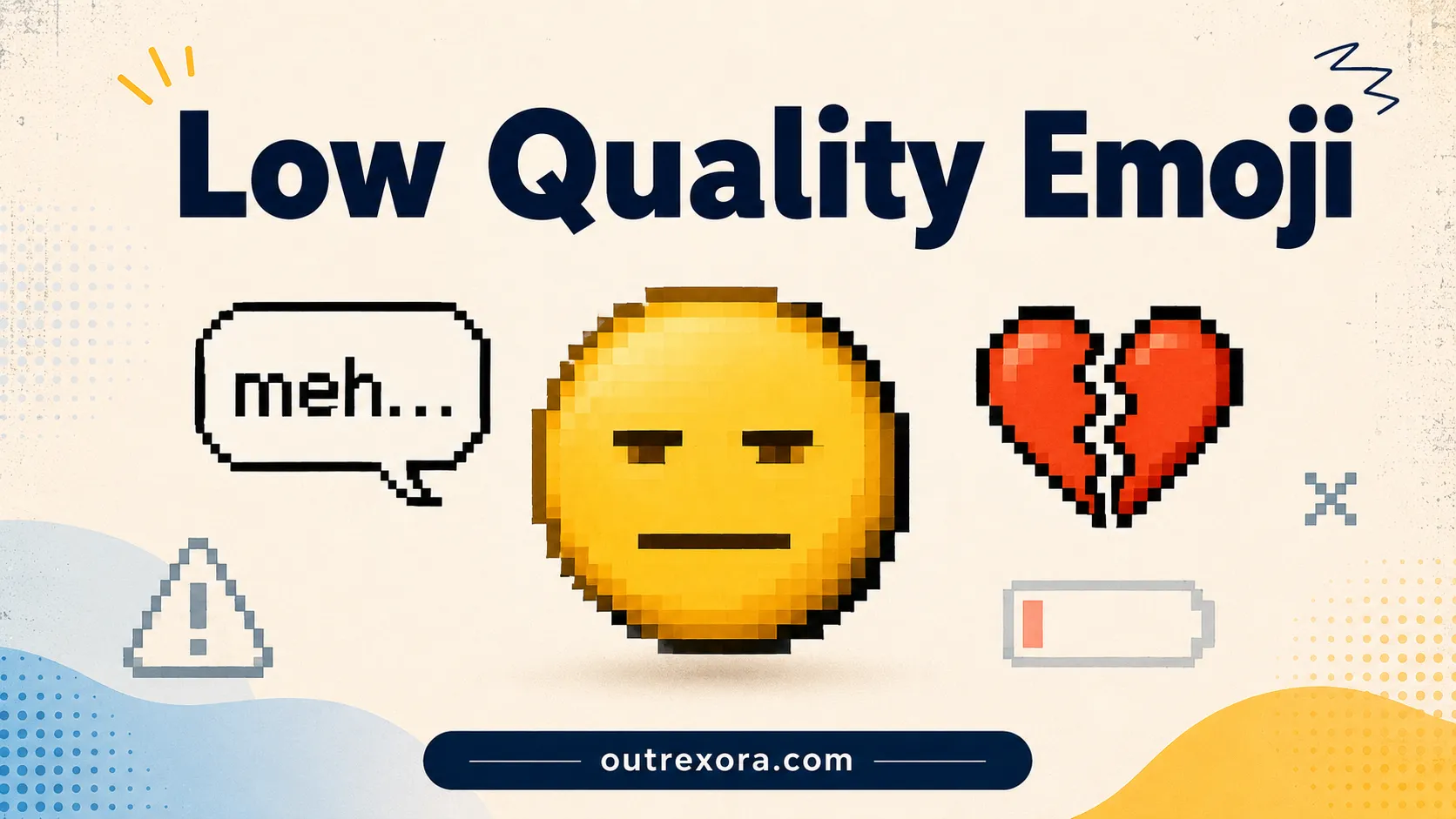
Sometimes a blurry, awkward, or hilariously bad reaction needs an emoji that matches the chaos.
I remember seeing a low resolution picture online and thinking, This is so bad that it is actually funny. That is where low quality emoji usage becomes useful.
These reactions can signal poor quality, awkwardness, irony, disappointment, or playful embarrassment depending on the conversation. Let’s explore the most useful options and how people use them.
Sometimes the worse the quality, the funnier the message becomes.
What do low quality emoji mean?
There is no official Unicode emoji named low quality emoji. Instead, people use certain reaction emojis to communicate that something looks blurry, badly made, awkward, outdated, or intentionally terrible.
The meaning depends heavily on the surrounding words. For example, 😭 can make a bad image feel hilarious, while 👎 can make your criticism much clearer.
Here are ten useful emojis commonly suited to low-quality, awkward, disappointing, or ironic situations:
| Emoji | Core meaning | Misread as | Best used when |
| 😭 | Overwhelmed laughter or emotion | Genuine sadness | Something is hilariously bad |
| 💀 | Extreme amusement or disbelief | Literal death | A terrible result is funny |
| 🫠 | Awkwardness or embarrassment | Physical melting | Something went badly |
| 🥴 | Confusion or discomfort | Being silly | Quality feels strange or questionable |
| 😵💫 | Confusion or overload | Serious distress | A result is messy or chaotic |
| 🤡 | Self-mockery or foolishness | Insult | A mistake deserves playful criticism |
| 🤣 | Strong laughter | Simple happiness | Bad quality is genuinely funny |
| 📉 | Decline or dropping quality | Business chart | Something clearly got worse |
| 🗑️ | Poor value or rejection | Literal trash | Something is jokingly called terrible |
| 👎 | Disapproval | Serious criticism | You want a direct negative reaction |
Meaning & Example
❤️ Red Heart
Meaning: Deep love, affection. And emotional connection.
Example 1: Even this low quality photo is special ❤️
Example 2: I still love this memory ❤️
😭 Loudly Crying Face
Meaning: Intense emotion that can express sadness, laughter. Or overwhelming reactions.
Example 1: This low-quality picture is sending me 😭
Example 2: Why did we think this looked good 😭
💀 Skull
Meaning: Extreme amusement, disbelief. Or a reaction to something ridiculously funny.
Example 1: The quality got worse every second 💀
Example 2: This picture is unbelievably bad 💀
🫠 Melting Face
Meaning: Awkwardness, embarrassment, discomfort. Or feeling overwhelmed.
Example 1: I uploaded the wrong version 🫠
Example 2: Please ignore that blurry screenshot 🫠
🥴 Woozy Face
Meaning: Confusion, discomfort, silliness. Or an odd feeling.
Example 1: Why does this image look like that 🥴
Example 2: The quality is definitely questionable 🥴
😵💫 Face with Spiral Eyes
Meaning: Confusion, dizziness. Or being overwhelmed by something chaotic.
Example 1: I cannot even understand this blurry image 😵💫
Example 2: What happened to the resolution 😵💫
🤡 Clown Face
Meaning: Playful self-mockery, foolishness. Or admitting a ridiculous mistake.
Example 1: I posted the unfinished version 🤡
Example 2: Me thinking this was high quality 🤡
🤣 Rolling on the Floor Laughing
Meaning: Very strong laughter at something extremely funny.
Example 1: This terrible edit is hilarious 🤣
Example 2: The old version looks so funny 🤣
📉 Chart Decreasing
Meaning: A downward trend, decline. Or noticeable drop.
Example 1: Image quality after compression 📉
Example 2: The resolution keeps dropping 📉
🗑️ Wastebasket
Meaning: Rejection, something unwanted. Or something jokingly described as terrible.
Example 1: This edit belongs in the trash 🗑️
Example 2: My first attempt was terrible 🗑️
How to use low quality emoji the right way
On WhatsApp, these emojis work especially well in personal conversations. A friend might send a blurry old photo. And a playful reaction can communicate your response without making the message overly serious.
For Instagram, context matters more. Instagram emojis often appear in captions, comments, Stories. And Reels, where a reaction can support an intentionally messy aesthetic or humorous post.
TikTok usage tends to lean toward humor, irony, and exaggerated reactions. A creator may use a reaction after showing an old image, awkward edit, or deliberately low-resolution clip.
Do:
- Match the emoji to the tone of your message.
- Use reactions playfully with friends.
- Combine an emoji with a short explanation when context could be unclear.
- Use copy paste emojis when you want a quick reaction.
Don’t:
- Use 👎 when someone may take it as harsh criticism.
- Assume every person interprets reaction emojis identically.
- Add too many emojis when one strong reaction already works.
- Use a joking reaction in a sensitive conversation without considering the context.
Best low quality emoji combos copy & paste
Romantic
- ❤️😭 When an old couple photo is blurry but meaningful.
- ❤️🫠 When a sweet memory feels emotionally overwhelming.
- 😭❤️ When a sentimental photo makes you emotional.
Cute
- 🫠😭 For an adorable but awkward picture.
- 🥴🤣 When something is weirdly cute and funny.
- 🤡😭 For laughing at your own embarrassing photo.
Flirty
- 🫠❤️ For a playful reaction to a charming message.
- 🥴❤️ When someone leaves you pleasantly flustered.
- 😭❤️ For an exaggerated reaction to a sweet compliment.
Missing someone
- 😭❤️ When an old low-quality photo brings back memories.
- 🫠❤️ When looking at an old picture feels emotional.
- 💀😭 For laughing and getting emotional over an old memory.
Good night
- 😭❤️ A playful reaction before saying good night.
- 🫠❤️ For an emotional late-night message.
- 💀😭 For joking about staying awake too late.
Trending low quality emoji in 2026
In 2026, reaction-based emoji use continues to fit naturally into casual conversations, short-form videos, comments, and meme-style posts. Rather than representing image quality literally, emojis are often used to exaggerate how someone feels about something.
😭 is especially useful for exaggerated reactions, while 💀 fits internet humor and disbelief. 🫠 works naturally with awkward moments. And 🤡 is useful when someone is making fun of their own mistake.
| Emoji | Why trending | Who uses it | Platform |
| 😭 | Strong reaction to funny or chaotic content | Casual users and creators | TikTok, Instagram, WhatsApp |
| 💀 | Short, dramatic reaction to humor | Meme and short-form audiences | TikTok, Instagram |
| 🫠 | Fits awkward and relatable situations | Casual texters and creators | WhatsApp, Instagram |
| 🤡 | Useful for self-deprecating humor | Meme-focused users | TikTok, Instagram |
As digital communication changes, emoji usage generally continues to adapt to new jokes, visual styles, memes, and conversational habits.
How to Reply When Someone Sends You the Low Quality Emoji
When the low quality emoji lands in a chat, it is usually shorthand for a moment, a plan. Or a mood. Your reply lands best when it answers that moment, so glance at the photo, story. Or message it came with before you write anything.
React to what they shared: if it came with a photo or an update, comment on that first. People send this emoji to highlight the moment, and noticing the moment is the reply they wanted.
Add one of your own: sending the same emoji back with a short line of your own keeps the exchange balanced. It says you are in the moment with them, not just watching it.
Ask about the plan: when the emoji hints at an activity, a trip, a meal. Or a purchase, one question about the details turns a reaction into a real conversation.
Keep it short: this emoji does its best work in quick, casual exchanges. One or two sentences is plenty, and a long serious reply can make a light moment feel heavy.
FAQs:
1. What is the most popular low quality emoji?
There is no single official low quality emoji. For humorous reactions to poor-quality content, 😭 and 💀 are popular choices because they can make an awkward or terrible result feel intentionally funny.
2. What does 😭 mean from a girl or boy?
The meaning usually depends on context rather than gender. Someone may use 😭 to show genuine emotion, exaggerated laughter, frustration, or amusement at something unexpectedly funny.
3. Why do emojis look different on iPhone vs Android?
Different operating systems use their own emoji artwork and designs. The underlying Unicode character is generally the same, but its appearance can change between Apple, Google, Samsung, and other platforms.
4. Are low quality emojis used differently in other countries?
Yes, interpretations can vary because online humor, slang, and messaging habits differ across cultures. The surrounding words usually provide the best clue to the intended meaning.
Cursed and Deep Fried Emojis Explained
To understand low quality emoji culture, you need to know the two signature styles:
Cursed emojis are familiar emojis that look wrong in a funny way: blurry, oddly colored, stretched. Or compressed until they feel unsettling. A grainy, stretched out crying emoji with the caption my phone at 1 percent trying to load a video is the classic example. They are perfect for describing feelings of being worn down, chaotic, or just plain weird.
Deep fried emojis take it further. Deep frying means layering an image with so many filters, sharpening passes. And recompressions that JPEG artifacts bloom across it like digital grease. The result looks like it survived a war inside a microwave, and that destruction is the joke. Deep fried faces dominate meme pages because the worse they look, the harder they hit.
Why is ugly funny? Three reasons. First, irony: a polished world of HD everything makes deliberate ugliness rebellious. Second, relatability: a distorted face matches how chaotic life actually feels. Third, exaggeration: a melting, pixelated face says I am barely holding it together louder than any clean emoji could.
10 Reaction Emojis for Low Quality Moments
Here are ten useful emojis commonly suited to low quality, awkward, disappointing, or ironic situations:
| Emoji | Core meaning | Misread as | Best used when |
|---|---|---|---|
| 😭 | Overwhelmed laughter or emotion | Genuine sadness | Something is hilariously bad |
| 💀 | Extreme amusement or disbelief | Literal death | A terrible result is funny |
| 🫠 | Awkwardness or embarrassment | Physical melting | Something went badly |
| 🥴 | Confusion or discomfort | Being silly | Quality feels strange or questionable |
| 😵💫 | Confusion or overload | Serious distress | A result is messy or chaotic |
| 🤡 | Self-mockery or foolishness | Insult | A mistake deserves playful criticism |
| 🤣 | Strong laughter | Simple happiness | Bad quality is genuinely funny |
| 📉 | Decline or dropping quality | Business chart | Something clearly got worse |
| 🗑️ | Poor value or rejection | Literal trash | Something is jokingly called terrible |
| 👎 | Disapproval | Serious criticism | You want a direct negative reaction |
👎 Thumbs Down
Meaning: direct disapproval. Use carefully, since it reads harsher than the playful faces above.
Example 1: This render is not it 👎
Example 2: Hard pass on this version 👎
Where Low Quality Emoji Memes Work Best
- Group chats: the best place to drop a single cursed emoji combo and disappear.
- Comments: short reactions get more likes because people instantly relate.
- Photo captions: one line plus one emoji is cleaner than a whole paragraph.
- Memes and shitposts: deep fried faces are native here, the uglier the better.
Where they do not work: serious conversations where someone is being vulnerable, long explanations where emojis cannot do the work. And professional chats where a cursed emoji reads as careless rather than funny.
How to Use Low Quality Emojis on Each Platform
On Instagram, context matters more. Emojis often appear in captions, comments, Stories. And Reels, where a reaction can support an intentionally messy aesthetic or humorous post. Cursed emojis thrive in meme comment sections.
On TikTok, usage leans toward humor, irony, and exaggerated reactions. A creator may use a reaction after showing an old image, an awkward edit, or a deliberately low resolution clip. Deep fried emoji overlays are a staple of the meme edit style.
Dos and Do Nots
Do match the emoji to the tone of your message. Do use reactions playfully with friends. Do combine an emoji with a short explanation when context could be unclear. Do use copy and paste emojis when you want a quick reaction.
Do not use 👎 when someone may take it as harsh criticism. Do not assume every person interprets reaction emojis identically. Do not add too many emojis when one strong reaction already works. Do not use a joking reaction in a sensitive conversation without considering the context. Do not mock someone’s personal struggles with 📉 decline jokes, which reads as cruel rather than funny.
Common Mistakes With the Chart Decreasing Emoji
The most common mistake is using 📉 for anything low in a literal sense, like low volume or low brightness, which confuses readers because the emoji specifically suggests a downward trend. Another error is dropping it into serious financial discussions as a joke when real money is involved, which can feel tone deaf. People also confuse 📉 with 📊, using the wrong one for neutral data talk. In professional chats, a bare 📉 with no numbers looks vague and alarming, so always add context.
Why Blurry Photos Became a Joke Format
Blurry photos became funny because they break the expectation of perfect pictures. Social feeds are full of sharp portraits, clean edits, and polished videos, so a grainy screenshot feels honest and unexpected. When someone shares a pixelated photo from an old phone, the joke is not really about the picture. It is about the memory, the awkward timing, or the fact that everyone still kept the photo anyway. A crying laughing emoji or a melting face emoji signals that the sender knows the quality is bad and finds that part charming.
Old photos add another layer. A low resolution picture from years ago carries nostalgia, even when faces are hard to see. Friends laugh because they remember the moment, not because the image looks good. That shared memory is what makes the reaction work. A short caption such as, Still my favorite photo, even if we look like ghosts, turns a technical flaw into a warm joke. The emoji simply marks the tone, so no one mistakes playful teasing for real criticism.
Low Quality Emoji Replies for Group Chats
Group chats are where these reactions shine, because speed matters more than polish. A single well chosen emoji can answer a blurry photo faster than a sentence, and it invites others to join the joke. Try a skull emoji when a photo is so bad that it becomes hilarious, or a melting face emoji when the photo captures an embarrassing moment you would rather forget. If a friend posts a failed screenshot, a rolling on the floor laughing emoji shows that you found it funny without needing a long comment.
Keep the reply short and kind. The best group chat reactions laugh with the sender, not at the sender. A line such as, This photo has survived five phones and still looks like this, celebrates the memory while keeping the joke light. Avoid piling on with harsh comments, especially if the photo shows someone feeling self conscious. One strong emoji, plus one friendly sentence, usually gets more laughs than a string of reactions that drown the conversation.
- Blurry throwback photo: pair a crying laughing emoji with a warm memory, so the joke feels affectionate.
- Failed screenshot: use a melting face emoji and a short apology, so the mistake stays funny instead of awkward.
- Overedited meme: add a skull emoji when the edit is so messy that it becomes the punchline.
- Old video clip: use a woozy face emoji to capture the chaotic energy of early phone cameras.
How to Make a Cursed Emoji Meme Without Overdoing It
A good cursed meme starts with one clear idea, such as tiredness, confusion, or a small daily failure. Pick one distorted face that matches that feeling, then add a short caption that explains the joke in plain words. Too many filters, too many emojis, or a long caption can hide the idea and make the meme hard to read. The strongest cursed memes look messy on purpose, but the joke itself stays simple and easy to grasp in a few seconds.
Test the meme by showing it to one friend before posting it widely. If they laugh and repeat the caption back to you, the idea works. If they ask what it means, the caption needs clearer words or a simpler image. Also check the audience. A cursed meme that works in a close friend group may confuse a wider audience that does not share the same jokes. When in doubt, keep the humor gentle, avoid mocking real people, and let the distorted face carry the exaggeration while your words stay kind and clear.
Conclusion:
A low quality emoji does not have to mean one specific thing because the phrase itself describes a style of reaction rather than an official Unicode character.
The right emoji can turn a blurry image, awkward mistake, or disappointing result into a funny conversation.
Use context, keep your reactions natural, and let the surrounding message make your intention clear.

I’m Noah Mitchell, an author at Outrexora.com, where I share clear, engaging, and informative content covering the latest news, insights, trends, and topics that matter to readers.