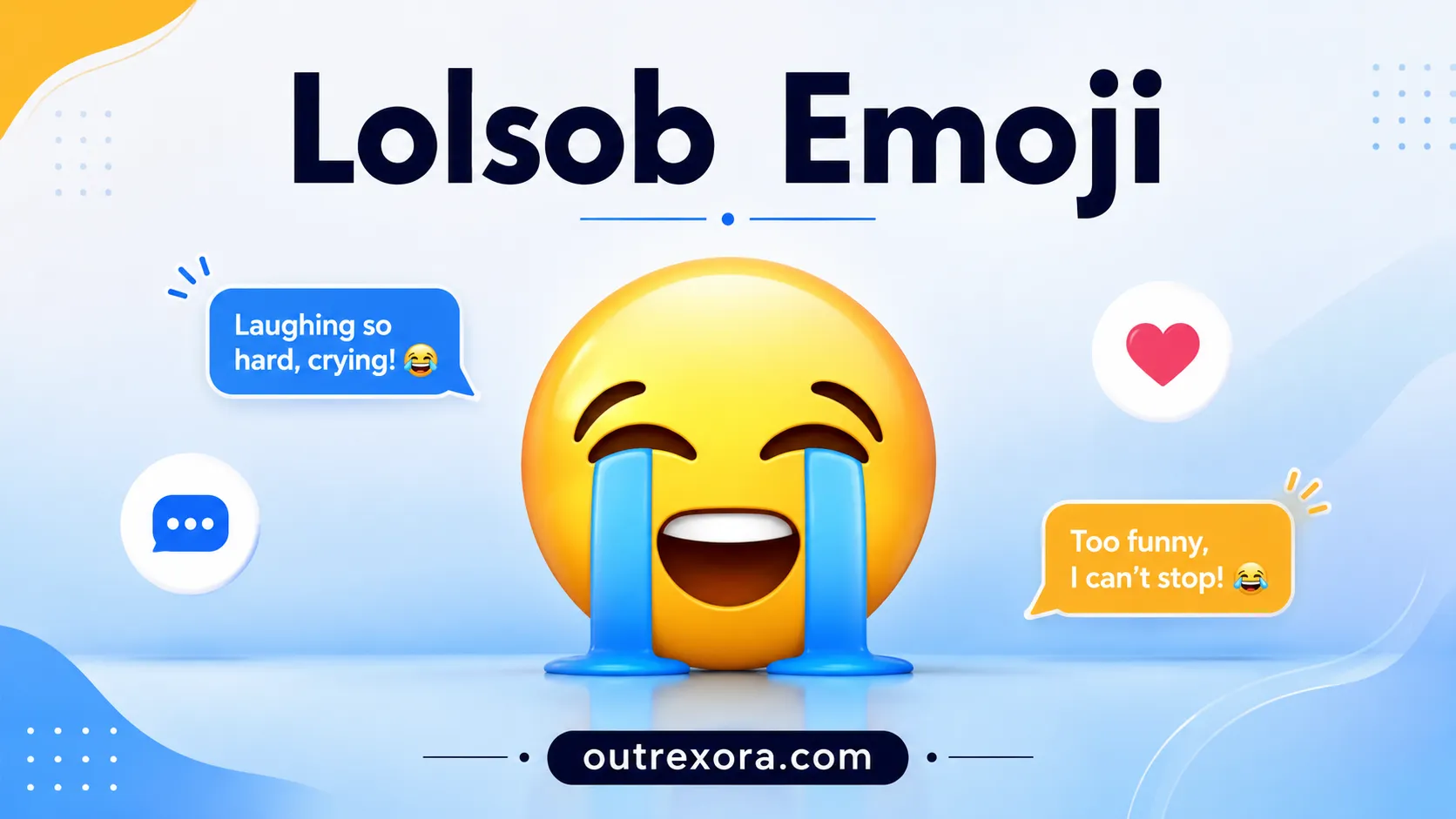
When something is so funny and painful that one emoji just cannot say it all.
I first noticed the lolsob emoji 😭😂 in chats where someone was laughing at a situation that was also slightly painful, awkward. Or unbelievable.
It felt more expressive than simply sending a laughing emoji. The combination quickly became useful for everyday reactions, especially in WhatsApp emojis, Instagram emojis, and TikTok comments.
If you have ever laughed through an embarrassing moment or found a problem ridiculously funny, this emoji style probably fits your reaction perfectly.
The lolsob emoji captures that wonderfully confusing moment when laughter and tears happen together.
What do lolsob emoji mean?
The lolsob emoji usually combines laughter and tears to show an intense reaction. It can communicate I’m laughing so hard, this hurts but it’s funny, or I cannot believe this happened.
Context matters. A message like I forgot my own password again 😭😂 sounds humorous, while That ending destroyed me 😭🥲 can feel more emotional.
Here are closely related emojis commonly used around this reaction:
| Emoji | Core meaning | Misread as | Best used when |
| 😭 | Intense crying or overwhelming emotion | Genuine sadness only | A reaction feels dramatically emotional |
| 😂 | Laughing hard | Simple amusement | Something is genuinely hilarious |
| 🥲 | Smiling through emotion | Pure happiness | A moment is bittersweet |
| 🤣 | Extreme laughter | Just casual laughing | Something is unbelievably funny |
| 😅 | Nervous or relieved laughter | Happiness | You are laughing through awkwardness |
| 😢 | Sadness or disappointment | Dramatic reaction | The mood is genuinely down |
| 🥹 | Strong emotional reaction | Crying | Something feels touching or overwhelming |
| 💀 | I’m dead from laughter | Literal death | Internet humor feels too funny to handle |
| 🤭 | Suppressed laughter or embarrassment | Shyness | You are trying not to laugh |
| 😆 | Big cheerful laughter | Mild happiness | A playful reaction fits the moment |
❤️ Red Heart
Meaning: Deep love, affection, and emotional connection.
Example 1: I miss you ❤️
Example 2: You are my everything ❤️
😭 Loudly Crying Face
Meaning: Intense emotion, especially crying or feeling overwhelmed.
Example 1: That was too much 😭
Example 2: I cannot believe this happened 😭
😂 Face With Tears of Joy
Meaning: Strong laughter at something extremely funny.
Example 1: Your message took me out 😂
Example 2: I am laughing so hard 😂
🥲 Smiling Face With Tear
Meaning: A smile mixed with emotion, sadness. Or bittersweet feelings.
Example 1: Everything is fine, I guess 🥲
Example 2: I finally finished it 🥲
🤣 Rolling on the Floor Laughing
Meaning: Extremely strong laughter or an exaggerated funny reaction.
Example 1: That joke was wild 🤣
Example 2: I cannot stop laughing 🤣
😅 Grinning Face With Sweat
Meaning: Nervousness, awkwardness, relief. Or embarrassed laughter.
Example 1: I almost forgot again 😅
Example 2: That was awkward 😅
😢 Crying Face
Meaning: Sadness, disappointment. Or emotional hurt.
Example 1: I really miss that place 😢
Example 2: That ending was sad 😢
🥹 Face Holding Back Tears
Meaning: Being deeply touched, emotional. Or close to tears.
Example 1: That message was so sweet 🥹
Example 2: You remembered 🥹
💀 Skull
Meaning: Internet slang for being overwhelmed by humor or shock.
Example 1: That reply finished me 💀
Example 2: I cannot handle this 💀
🤭 Face With Hand Over Mouth
Meaning: Hidden laughter, embarrassment, surprise. Or playful secrecy.
Example 1: I probably should not laugh 🤭
Example 2: Okay, that was funny 🤭
How to use lolsob emoji the right way
On WhatsApp, this reaction works especially well in personal conversations. Friends and family often use it after funny stories, awkward situations, unexpected messages, or exaggerated complaints.
For example: You really sent that to the wrong person 😭😂 makes the reaction feel playful rather than serious.
On Instagram, the same style can work in comments, captions, and Stories. Instagram emojis often become part of the overall visual style. So short combinations can make reactions feel more expressive without adding extra text.
On TikTok, the lolsob style fits humor, irony, unexpected plot twists, and relatable situations. Creators and viewers often use dramatic reactions when a video is funny precisely because something went terribly wrong.
Do: Match the emoji intensity to the message, use combinations naturally, and consider who you are talking to.
Don’t: Add emotional emojis to a genuinely serious message, assume everyone interprets them identically. Or overload a short reply with unnecessary symbols.
Best lolsob emoji combos copy & paste
Romantic
👉 ❤️😭 When you miss someone you love.
👉 ❤️🥹 For a deeply touching romantic moment.
👉 😭😂❤️ When affection and playful laughter mix.
Cute
👉 🥹🤭 A sweet reaction that feels a little shy.
👉 🥲🥹 For a wholesome but emotional moment.
👉 😅🥹 When something cute leaves you awkwardly emotional.
Flirty
👉 🤭😂 A playful response to teasing.
👉 ❤️🤭 A shy reaction to a sweet message.
👉 😭😂🤭 When flirting becomes hilariously awkward.
Missing someone
👉 😭❤️ A simple emotional response to missing someone.
👉 🥲❤️ When you are trying to stay positive while missing them.
👉 😢😭❤️ For a stronger emotional reaction.
Good night
👉 🥹❤️ A warm good night feeling.
👉 😭❤️ When you do not want the conversation to end.
👉 🥲🤭❤️ A playful, slightly emotional sign off.
Trending lolsob emoji in 2026
In 2026, expressive combinations continue to fit short form conversations because they can communicate several emotions at once. The lolsob style is particularly useful when plain text feels too serious or a single emoji feels incomplete.
😭 remains useful in dramatic internet reactions, while 😂 works naturally when the main point is humor. 💀 is common in exaggerated online reactions, especially where humor depends on irony or an over the top response.
Younger users, meme communities, and content creators frequently adapt these reactions to fit the tone of posts and comments. Their popularity can vary between WhatsApp, Instagram, and TikTok depending on the conversation style.
| Emoji | Why trending | Who uses it | Platform |
| 😭 | Dramatic reactions fit fast online humor | Younger users, creators | TikTok, Instagram |
| 😂 | Clear and familiar laughter | General users | WhatsApp, Instagram |
| 💀 | Strong ironic reaction | Meme focused users | TikTok, Instagram |
| 🥹 | Expressive emotional response | Creators, friends | Instagram, WhatsApp |
Emoji language keeps evolving as people combine familiar symbols in new ways to express humor, emotion, irony, and everyday reactions.
FAQs:
1. What is the most popular lolsob emoji?
The most recognizable lolsob combination is usually 😭😂 because it blends intense emotion with laughter. People often use it when something is both funny and overwhelming.
2. What does 😭😂 mean from a girl or boy?
The meaning usually depends more on context than gender. From anyone, 😭😂 can suggest strong laughter, dramatic humor, awkwardness, or laughing at an unfortunate situation.
3. Why do emojis look different on iPhone vs Android?
Different operating systems use their own emoji artwork and designs. The underlying Unicode character can be the same even though its appearance changes across devices.
4. Are lolsob emoji used differently in other countries?
Yes, interpretations can vary with language, internet culture, and local texting habits. However, laughter, crying, and dramatic reactions are broadly understood in many online communities.
The Great Meaning Shift: Why 😭 Now Means Laughing Too
To read lolsob properly in 2026, you need the backstory of the crying face. A decade ago 😭 meant one thing: real tears, real sadness. Then internet humour changed the rules, and the crying face changed with them.
Among Gen Z and Gen Alpha, 😭 now primarily signals intense laughter. It replaced the older “I am dead” energy, which had replaced “LOL” before it. Each generation needed a louder way to say that something is funny. And the crying face won because nothing looks more dramatic than full streams of tears. The intensity is the point: you are laughing so hard you are crying.
This explains the classic lolsob reading. When someone sends 😭😂 after a joke, both faces agree on laughter. And the crying face simply turns the volume to maximum. The combo feels like laughing through tears rather than a mix of sadness and joy.
The second half of the shift is ironic exaggeration: 😭 for minor annoyances, precisely because the tears are too big for the problem. “My coffee went cold 😭” is not grief over coffee. It is a joke about how dramatic the disappointment feels. The crying face also stretched toward tenderness: “this puppy video fixed my whole day 😭” uses tears for overwhelming sweetness, not sorrow. If the words are happy, the tears mean happy too.
When 😭 Means Sadness, Joy, or Being Moved
The crying face did not abandon its original job. 😭 still means genuine sadness in the right context, which is exactly why context decides everything.
Genuine grief. When the words describe loss or real hurt, the tears mean tears. “My grandmother is in hospital 😭” asks for sympathy, never laughter. No laughing face appears in these messages, and that absence is the signal.
Overwhelmed with love. Pair it with a heart and the tears turn warm. “You remembered my birthday across three time zones 😭❤️” means loved to the point of crying. The heart tells you the tears are happy.
Deeply grateful. The combo 😭🙏 reads as thankfulness too big for words. “You drove two hours to help me move 😭🙏” is gratitude with the volume turned up.
Bittersweet and moved. Add sparkles and you get beauty mixed with ache. “Watched our old holiday videos tonight 😭✨” holds nostalgia and fondness at once. At the joking extreme, 😭💀 means playful destruction: “That plot twist ended me 😭💀”.
The rule of thumb: read the words, then the faces. Happy words plus 😭 mean happy tears. Painful words plus 😭, with no laughing face nearby, mean real tears.
The Full Lolsob Family: Combos Ranked by Intensity
Lolsob is not one pairing. It is a family of combos, each with its own volume setting, ranked from softest to loudest.
| Combo | Vibe | What it says | Example |
|---|---|---|---|
| 🥲😂 | Soft and bittersweet | Funny with a tender edge | Graduated today, going to miss this place 🥲😂 |
| 😅😂 | Nervous relief | Awkward, but it ended fine | Waved at the driver thinking he was my date 😅😂 |
| 😂🥲 | Sweet laughter | Happy with a soft twist | He remembered our song from year one 😂🥲 |
| 😭😂 | The classic | Laughing through the pain | My alarm stayed silent on exam day 😭😂 |
| 😂😭 | Playful twin | Laughter first, ache second | Joked about quitting, then saw my inbox 😂😭 |
| 😭🤣 | Turned up | Catastrophically funny | He fell off the chair mid presentation 😭🤣 |
| 😭✨ | Beautifully sad | Nostalgic and moved | Found my childhood photos in the attic 😭✨ |
| 😭❤️ | Overwhelmed with love | Touched to tears | They surprised me at the airport 😭❤️ |
| 😭💀 | Maximum drama | Emotionally destroyed, joking | The finale killed my favourite character 😭💀 |
Start with the classic 😭😂 and reach for the louder combos only when the joke earns them.
Lolsob Texting Examples for 2026
Context is everything with this combo. Here are fresh examples grouped by the situations where lolsob shines.
Everyday fails and mishaps
- Told the waiter “enjoy your meal” as he walked away 😭😂
- Locked myself out taking the bins out, in slippers 😭😂
- Reheated the same coffee three times, never drank it 😭😂
Relatable money and adulting moments
- Payday arrived and left in the same afternoon 😭😂
- My savings plan versus my delivery history 😭😂
School, study, and exam season
- Revised the formulas, the exam asked for definitions 😭😂
- Submitted the essay at 11:59 with a title typo 😭😂
- A library nap turned into a full sleep cycle 😭😂
Work chats and office life
- Replied “thanks!” to a message not meant for me 😭😂
- Sent the client draft with placeholder text inside 😭😂
- Dress code said casual Friday, I wore a suit 😭😂
Gaming and group chats
- Won the round then fell off my own build 😭😂
- Saved the clip where I miss every shot 😭😂
- Ranked up at midnight, lost it by morning 😭😂
Comments and captions
- POV: the group chat screenshots your typo 😭😂
- Day one of the diet meets the takeaway menu 😭😂
Parenting and family life
- Packed lunches all week, school had pizza day 😭😂
- Bedtime took longer than my work shift 😭😂
- The baby slept through the night, so I did not 😭😂
Every example pairs a small disaster with a laugh. That is the lolsob formula: the moment everyone involved can laugh about it, the combo fits.
How Different Generations Read 😭😂
The same two faces can land very differently depending on who is reading.
Parents and older texters often use a single 😂 for the same joke a teenager would answer with a full 😭😂 meltdown. They learned emoji when each face had one literal job, so 😭 still looks like crying to them first. A mum replying 😂 to your story is not underwhelmed. She is speaking the older dialect fluently.
Gen Z and younger millennials reach for dramatic pairings by default. For them, intensity is sincerity: a bigger reaction means a more genuine one. A lone 😂 can even read as dry among younger users, while 😭😂 reads as warm and real.
This gap creates a small workplace risk. An older colleague may read your 😭😂 as actual distress, while a younger one reads it as peak humour. In mixed age groups, save lolsob for clearly lighthearted moments. The fix is simple: mirror the room and reply in the register the other person uses.
Lolsob Emoji on iPhone vs Android
Because the combo is built from two standard faces, platform differences come down to how 😭 and 😂 are drawn.
On iPhone, the loudly crying face shows heavy streams pouring from squeezed shut eyes, which reads as full melodrama. Beside it, the tears of joy face looks bright and round. The Apple pairing therefore skews extra theatrical, which is why the combo feels so at home in dramatic comment sections.
On Google’s Android set, the crying face is a touch softer with rounder tears. And the laughing face has a wider grin. The overall effect is slightly warmer and less anguished, which suits friendly group chats where the joke is gentle.
Samsung draws both faces with a glossy finish, landing between the two. WhatsApp’s own designs keep both faces bold and simple, which helps the combo stay legible at small sizes. On Windows, the flat outlined style makes the tears look tidier. So the combo reads a little calmer in desktop messages.
None of these differences change the meaning. Whether the tears look torrential or tidy, readers in 2026 recognise the pattern instantly. The combo is one of the most platform stable reactions in the emoji set.
When NOT to Use the Lolsob Combo
Lolsob is a joke delivery system, and jokes have boundaries.
Real bad news. If someone shares grief, illness, or loss, 😭😂 reads as mocking no matter how you meant it. Reply with words, or with a simple ❤️ if you want a symbol.
Serious conversations. Apologies, disagreements, and emotional talks need sincerity the crying face cannot carry. Dramatic tears make a real apology look like a performance.
Professional messages. Job applications, client emails, and formal announcements should stay emoji light. If humour fits at all, a single 😅 carries awkwardness without the melodrama.
People you barely know. Strangers cannot hear your tone of voice. Until someone knows your style, the combo can read as laughing at them rather than with them. The alternative is easy: match the emoji to the room. Use 😅 for awkwardness, ❤️ for sympathy, and plain honest sentences when the moment matters.
How to Reply When Someone Sends You the Lolsob Emoji
A lone lolsob emoji with no words around it can mean several things. So the safest reply starts from the messages just before it. Read the last few lines, decide whether the mood is serious, playful. Or somewhere in between, and then answer that mood rather than the symbol alone.
Match the energy: if the chat has been light, keep your reply light too. A short reaction in the same tone tells the sender you understood them without making the moment bigger than it is.
Name the feeling: putting the emotion into words, kindly and without guessing too hard, works in almost every case. It shows you paid attention and gives the sender an easy way to confirm or correct you.
Ask one short question: when the tone is genuinely unclear, a simple check in question beats a wrong assumption. It keeps the conversation moving and avoids an awkward misread.
Send one back, with words: returning the same emoji plus one real sentence is the warmest option of all. The emoji mirrors their feeling, and the sentence makes sure your meaning cannot be missed.
Lolsob Emoji for Friendship Fails and Shared Embarrassment
Friendship fails are the natural home of the lolsob combination, because the best friend stories are often embarrassing in hindsight. A message such as sent the wrong screenshot again with this pairing tells friends that the mistake was funny, not tragic, and it invites them to laugh with you rather than at you. Shared embarrassment becomes bonding when everyone has a similar story, and the crying laugh signals that the storyteller is in on the joke.
The combination also helps friends recover quickly from small social slips. A typo in a group chat, a wrong name in a message, or a voice note sent to the wrong person can feel mortifying for a minute. A lolsob reply turns that minute into a joke, and the group moves on with warmth intact. The key is timing: use it while the moment is still light, and switch to plain words if anyone in the group seems genuinely upset.
Lolsob Emoji for Creative Work and Relatable Content
Creators use lolsob to show the messy side of creative work without losing their audience. A caption such as edited for hours, still found a typo with this pairing tells followers that perfection is a process, not a starting point. Audiences love that honesty, because it mirrors their own experience with school, work, and personal projects. The crying laugh makes the struggle relatable, while the words beside it show that the creator kept going anyway.
Relatable content works best when the failure is small and universal. A burnt dinner, a missed alarm, or a presentation glitch earns a warm lolsob reaction, while a serious setback deserves plain words and support. Creators who respect that line build trust, because followers learn that humour will never come at the expense of real pain. That trust keeps audiences returning, even when the content is simply about an ordinary bad day.
Frequently Asked Questions About the Lolsob Emoji
What does the lolsob combination actually mean? It usually means laughing so hard that it hurts, or laughing through an embarrassing or painful moment. Both faces agree on intensity, with the crying face turning the laughter up to maximum.
Can older readers misread it? Yes. Older texters may read the crying face literally as sadness first. In mixed age chats, use it only for clearly lighthearted moments, and add words that confirm the joke.
When should I never use lolsob? Never use it for grief, illness, loss, apologies, or serious disagreements. Dramatic tears in those moments read as mocking, no matter how the sender meant them.
Conclusion
The lolsob emoji is useful when ordinary words cannot capture the full reaction.
If you are texting on WhatsApp, commenting on Instagram. Or reacting on TikTok, context makes the combination work.
Keep your emoji choices natural, and let the conversation decide how dramatic your reaction should feel.

I’m Ava Richardson, a passionate writer and author at Outrexora.com, where I share engaging, informative, and easy-to-understand content on the latest news, insights, and trends. My goal is to bring readers useful information in a clear and enjoyable way.