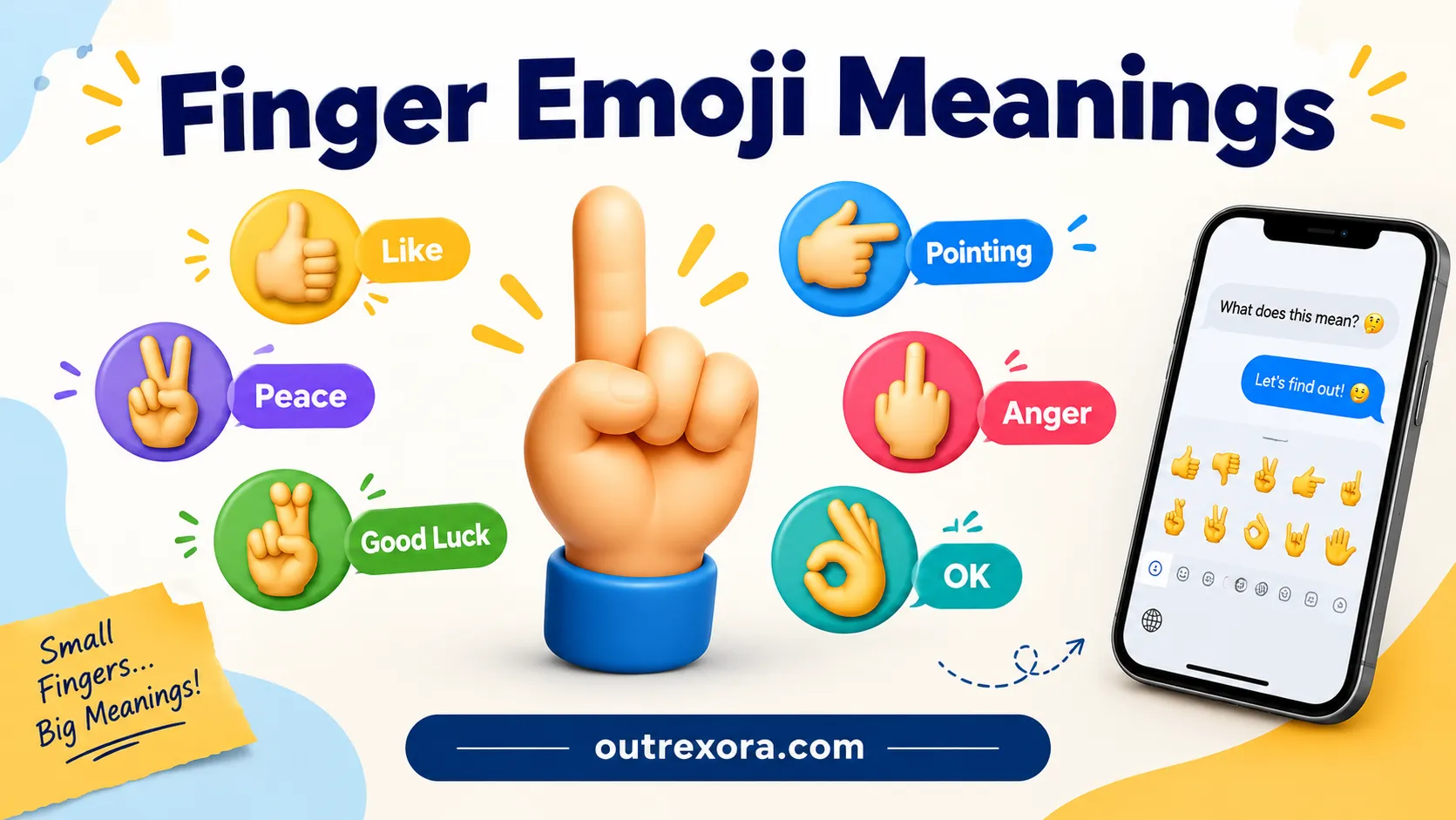
A tiny hand gesture can completely change the tone of a message.
I have often seen how one simple finger emoji can make a text feel playful, confident, supportive, or even confusing.
That is why understanding finger emoji meanings matters when you are chatting, commenting, or creating social posts. Different gestures can express direction, agreement, teasing, emphasis, or attitude without adding many words.
Let’s look at the most useful finger emojis, how context changes their tone. And where they work best across WhatsApp, Instagram, and TikTok.
The right finger emoji can say exactly what your words leave unsaid.
What do finger emoji meanings mean?
Finger emojis are digital hand gestures that add visual emotion or emphasis to everyday messages. Their meaning usually depends on the gesture, surrounding words, and relationship between the people chatting.
For example, pointing emojis can direct attention, while a crossed-fingers gesture can express hope or encouragement. A finger-heart-style gesture can feel affectionate, whereas a raised finger may simply emphasize an important point.
| Emoji | Core meaning | Misread as | Best used when |
|---|---|---|---|
| 👆 | Attention, above, emphasis | Bossy instruction | Highlighting something |
| 👇 | Below, look here, emphasis | Commanding | Directing attention downward |
| 👉 | Pointing, direction | Bluntness | Highlighting a person or idea |
| 👈 | Direction, pointing back | Confusion | Drawing attention left |
| ☝️ | One, attention, important point | Warning | Making a clear point |
| 🖕 | Insult or strong disagreement | Playful teasing | Only when the relationship and context make it appropriate |
| 🫵 | Direct attention toward someone | Confrontation | Calling someone out playfully or directly |
| 🤞 | Hope, luck, wishing | Promise | Showing hope or encouragement |
| ✌️ | Peace, victory, casual positivity | Simple counting | Friendly posts and messages |
| 🤏 | Small amount or “just a little” | Sarcasm | Describing something tiny |
Finger Emoji Cards
👆 Up Finger
Meaning: Attention, emphasis. Or directing someone toward something above.
Example 1: Check the message above 👆
Example 2: This part is important 👆
👇 Down Finger
Meaning: Directing attention below or emphasizing something underneath.
Example 1: See the details below 👇
Example 2: The answer is right here 👇
👉 Right Finger
Meaning: Pointing toward something, someone. Or an idea.
Example 1: Look at this 👉
Example 2: Your turn is next 👉
👈 Left Finger
Meaning: Pointing toward the left or drawing attention back to something.
Example 1: Check that message 👈
Example 2: The link is over there 👈
☝️ Index Up
Meaning: One point, attention. Or highlighting an important idea.
Example 1: Remember one thing ☝️
Example 2: I have an idea ☝️
🖕 Middle Finger
Meaning: A strong rude gesture commonly expressing anger, rejection. Or insult.
Example 1: That was seriously annoying 🖕
Example 2: Some jokes use this gesture for attitude 🖕
🫵 Index Pointing at Viewer
Meaning: Directly addressing or pointing toward another person.
Example 1: This message is for you 🫵
Example 2: You already know who you are 🫵
🤞 Crossed Fingers
Meaning: Hope, luck, encouragement. Or wishing for a positive result.
Example 1: Hope everything goes well 🤞
Example 2: Wish me luck 🤞
✌️ Victory Hand
Meaning: Peace, victory, positivity. Or a relaxed friendly mood.
Example 1: We did it ✌️
Example 2: Have a great day ✌️
🤏 Pinching Hand
Meaning: Something small, a tiny amount. Or “just a little.”
Example 1: Give me just a little 🤏
Example 2: It was this small 🤏
How to use finger emoji meanings the right way
On WhatsApp, finger emojis often feel personal and expressive. They can emphasize a sentence, point toward an earlier message, or make a casual conversation more playful.
On Instagram, they can support captions, comments, stories, and visual branding. Pointing gestures are especially useful when directing followers toward information, a link, or a featured part of a post.
On TikTok, the same gestures can take on humorous or ironic tones. Creators often combine familiar expressions with short captions to make a joke or emphasize a reaction.
A simple rule is to consider your relationship with the reader before sending a gesture. What feels funny between friends may sound rude in a formal conversation.
Do: Match the gesture with your words, use it naturally, and consider the context.
Don’t: Assume every gesture has exactly one meaning or use an aggressive-looking gesture where the tone is unclear.
Best finger emoji meanings combos — copy & paste
These copy paste emojis can add a little more personality without making your message complicated.
Romantic
👉❤️ — Pointing toward someone you care about.
🤞❤️ — Sending hopeful romantic feelings.
👆❤️ — Emphasizing affection or an important message.
Cute
🤏❤️ — A tiny, sweet expression of affection.
✌️❤️ — A cheerful and friendly combination.
🫵❤️ — Directing affection toward someone special.
Flirty
👉🫵 — Playfully putting the attention on someone.
🫵🤞 — A teasing way to wish someone luck.
☝️🫵 — Calling someone out in a playful conversation.
Missing Someone
👉❤️ — Pointing toward the person you are thinking about.
🫵❤️ — Making the message feel personally directed.
🤞❤️ — Showing hope for seeing someone again.
Good Night
👇❤️ — Drawing attention to a sweet closing message.
✌️❤️ — Ending the conversation with a relaxed feeling.
🤞❤️ — Sending warm wishes before sleep.
Trending finger emoji meanings in 2026
In 2026, familiar hand gestures continue to fit naturally into short-form messages, captions, comments, and reaction-based conversations. Their appeal comes from being quick to understand while still leaving room for humor or personal interpretation.
Younger users and content creators commonly use pointing gestures to guide attention, while casual chatters use familiar gestures to add tone without writing another sentence. The same emoji can also feel different depending on the caption around it.
| Emoji | Why trending | Who uses it | Platform |
|---|---|---|---|
| 🫵 | Direct, playful addressing | Creators and casual users | TikTok, Instagram |
| 🤞 | Easy way to express hope | Friends and everyday chatters | WhatsApp, Instagram |
| 👉 | Strong visual emphasis | Creators and commenters | Instagram, TikTok |
| ✌️ | Simple, familiar positivity | Broad social audiences | Instagram, WhatsApp |
As digital conversations evolve, finger gestures continue to show how a small visual symbol can add personality to very short messages.
FAQs:
1. What is the most popular finger emoji?
There is no single finger emoji that has one universal meaning or popularity level everywhere. Familiar gestures such as 👉, 👆, and ✌️ are widely recognizable and easy to use in everyday conversations.
2. What does a finger emoji mean from a girl or boy?
The meaning usually depends more on the message and relationship than on gender. A gesture can be friendly, playful, romantic, or direct depending on the surrounding conversation.
3. Why do emojis look different on iPhone vs Android?
Emoji designs are created by individual platforms and operating systems, so the artwork can vary between devices. The underlying Unicode character generally remains the same.
4. Are finger emojis used differently in other countries?
Yes. Gestures can have different cultural associations in different regions. When communicating internationally, context is especially important because a familiar gesture may carry a different social meaning elsewhere.
Finger Emojis at a Glance
Finger emojis are digital hand gestures: visual shortcuts for direction, emphasis, emotion, and attitude. The golden rule is that gesture plus context equals meaning. 👉 after “look at this” is helpful direction. 👉 after “you know who you are” is a playful accusation. The hand never changes; the sentence does all the steering.
| Emoji | Name | Usual meaning | Best moment to use it |
|---|---|---|---|
| 👆 | Backhand index pointing up | “Look above” | Referring to an earlier message |
| 👇 | Backhand index pointing down | “Look below” | Directing to a link or caption |
| 👉 | Backhand index pointing right | Direction, highlighting | Pointing at a person or idea |
| 👈 | Backhand index pointing left | Pointing back | Referring to something previous |
| ☝️ | Index pointing up | One key point | Making a reminder or rule |
| 🫵 | Index pointing at the viewer | Direct address | “This is for you” moments |
| 🤞 | Crossed fingers | Hope, good luck | Wishing and encouragement |
| ✌️ | Victory hand | Peace, celebration | Friendly sign offs |
| 🤏 | Pinching hand | Tiny amount | “Just a little” jokes |
| 🤌 | Pinched fingers | Emphasis, “what do you want” | Dramatic emphasis |
| 🖕 | Middle finger | Strong insult | Only with close friends |
The Pointing Family: Directing Digital Attention
Pointing emojis are the traffic signs of texting. 👆 sends eyes upward, perfect for “check the message above” or highlighting a pinned post. 👇 does the reverse, the classic companion to links, captions. And “details below” announcements.
👉 and 👈 handle sideways direction. 👉 pushes attention forward: “your turn 👉”. 👈 pulls it back: “that message 👈 said it best”. Used together, they frame a choice, “this 👈 or this 👉”. Or create a playful tug of attention across the screen.
The pair 👉👈 has developed a second meaning: indecision. “👉👈 I cannot decide” reads as shy hesitation, like pointing at both choices at once. And the tone is informal and light.
☝️ is the professor of the family. A single raised index finger means “one important thing” or a gentle “hold on”: “☝️ remember to bring ID”. 🫵 is its bolder cousin, pointing straight at the viewer. It makes messages feel personally addressed: “🫵 yes, you, read this”. On TikTok, 🫵 became a meme format for calling out relatable behaviors, which is why it feels both direct and funny.
Hope, Peace, and Tiny Things
🤞 is one of the warmest gestures in the set. Crossed fingers mean hope, luck, and wishing, borrowed from the old superstition of crossing fingers to ward off bad outcomes. Text it before exams, interviews, and announcements: “fingers crossed for you 🤞”.
✌️ carries a remarkable history, from 1960s counterculture peace symbol to casual friendly sign off. Today “✌️” at the end of a message reads as relaxed positivity, somewhere between “peace out” and “all good”. It is one of the safest, most universally liked gestures you can send. And it can also mean the number two, as in “two more days ✌️”.
🤏 is the comedian. The pinching hand shows a tiny amount, and it excels at self deprecating humor: “my patience today 🤏”. It can also describe literal smallness, a pinch of salt, a short wait, a little progress.
The Italian Pinched Fingers 🤌
🤌 deserves its own section because most guides skip it. Yet it is one of the most expressive hand emojis ever added. Originally an Italian hand gesture meaning roughly “what do you want” or “what are you saying,” it has traveled far beyond Italy.
In everyday texting, 🤌 now works as a general purpose emphasis tool: exasperation (“🤌 what is taking so long”), perfection (paired with food or fashion, like a chef’s kiss in emoji form). Or dramatic Italian style flair.
Example: “This pasta recipe is flawless 🤌” The emoji adds a stamp of chef approved approval that no words quite match. Use it with warmth and humor; aimed at strangers, the “what do you want” edge can sting.
The Middle Finger: Handle With Care
🖕 needs an honest, tasteful explanation because it is everywhere in meme culture. The middle finger is a well known insult gesture expressing anger, rejection, or defiance. Between close friends it often appears as rough humor, the digital equivalent of a playful shove.
The important boundaries are real. Sent to a stranger, a colleague. Or in anger, it reads as genuinely hostile and can damage relationships or even violate workplace conduct rules. Never use it where the tone is ambiguous, because the reader will assume the worst. Keep it away from professional chats entirely; no joke is worth a screenshot in the wrong hands.
More Hand Emojis Worth Knowing
Beyond the finger focused set, several hand emojis complete your gesture vocabulary. 👌 OK hand: “perfect” or “everything is good,” though it is offensive in some cultures. 🤙 Call me hand: “call me later” or “hang loose,” from surfer culture. 🤘 Sign of the horns: “rock on,” for concerts and high energy moments. 🫶 Heart hands: genuine love or appreciation without romance. 🤟 Love you gesture: “I love you” in American Sign Language. 🙏 Folded hands: please, thank you, prayer. Or respectful greeting depending on context. 👍 Thumbs up: broad approval, though offensive in a few cultures.
Texting Examples for Real Conversations
- Referring up: “The address is in the message above 👆”
- Link drop: “Full video is here 👇 you have to see the ending”
- Turn taking: “I went first, now it is your turn 👉”
- Key reminder: “☝️ Do not forget the tickets”
- Personal callout: “🫵 This reminder is specifically for you”
- Good luck: “Big presentation today 🤞 you will crush it”
- Friendly sign off: “Heading out, talk later ✌️”
- Choice framing: “Beach day 👈 or movie night 👉”
- Indecision: “👉👈 I honestly cannot pick, both sound amazing”
- Italian emphasis: “The lasagna was perfect 🤌 no notes”
- Celebration: “We passed! ✌️🤞 told you we had this”
Example Conversations
Directing attention
A: Where is the meeting link
B: Right below this message 👇
A: Found it, thanks
Good luck wishes
A: Interview starts in ten minutes, wish me luck
B: You have got this 🤞🤞
A: It went great, starting Monday
The playful callout
A: 🫵 You, yes you, the one who ate my leftovers
B: I have no idea what you mean 😇
A: The empty container says otherwise
Skin Tones: Making Gestures Your Own
Nearly every finger emoji supports five skin tone modifiers. Long press the emoji on most phones to choose, and the selection usually becomes your default. A 👉🏽 pointing from your own hand feels more personal than the default yellow, especially in one to one chats. The default yellow is always a safe neutral choice in mixed or professional company.
How to Use Finger Emojis on Each Platform
WhatsApp: finger emoji style
WhatsApp is where pointing fingers do their most practical work. 👆 and 👇 organize long chats by pointing to messages above and below. 👉 highlights the person a message is really for in a busy group. 🤞 is the standard good luck charm. And ✌️ softens goodbyes.
Instagram: finger emoji style
Instagram captions use 👇 as a call to action machine: “recipe below 👇”, “link in bio 👇”. Stories use 👉 to direct taps toward links and polls. ☝️ introduces tips in carousel posts. And 🫵 appears in relatable memes that call out the viewer.
TikTok: finger emoji style
TikTok gave 🫵 its meme renaissance, with creators pointing at the camera to accuse viewers of relatable habits. Pointing fingers in captions direct eyes to on screen text. 🤞 appears in good luck content, ✌️ in vlog sign offs, 🤏 in “this much patience” comedy. And 🤌 in cooking and fashion videos.
Platform Designs: How the Hands Differ
Finger emojis are among the most carefully drawn because the gesture must read instantly. On iPhone, pointing hands show a clean cartoon hand with a clearly extended index finger. Android’s versions use bolder outlines and shading, while Samsung’s hands look glossier and more dimensional. The differences are stylistic, but the direction and gesture stay unmistakable everywhere.
🤞 is the trickiest to draw well, since crossed fingers require showing one finger overlapping another. At small sizes it can resemble a pinching hand. So pair it with hopeful words. ✌️ is universally clean: two raised fingers in a V. 🖕 is deliberately unambiguous on every platform, which is worth remembering before you tap it.
Cultural Notes: When Gestures Travel
Hand gestures are famously culture specific. The victory hand with the palm facing outward means peace in most places. But with the palm facing inward it is an insult in the UK, Ireland, Australia, and New Zealand. The emoji ✌️ always shows the palm outward, so it stays safe.
Pointing itself carries cultural weight. In some cultures, pointing directly at people is considered rude. The 👉 emoji softens this because it is cartoonish and clearly symbolic. But in formal international communication, words often work better than a pointing hand.
The crossed fingers superstition behind 🤞 traces back centuries in Western culture. The pinching gesture behind 🤏 became a global meme almost overnight. The “call me” 🤙 hand shows how fast a gesture can travel from surfer culture to universal texting.
How to Reply When Someone Sends You the Finger Emojis
Replies to the finger emojis go wrong when people answer the picture instead of the person. The sender chose it for a reason, and that reason is almost always sitting in the conversation around it. So use those clues first and keep your first reply short.
For a friend: a relaxed, good humored answer is usually right. Friends send this emoji casually, and a casual reply keeps the exchange easy.
For someone you like: a warmer reply is safe when the chat is already warm. Keep it kind and simple, and let their next message set the pace.
For a serious moment: slow down and answer with care. If the emoji is carrying real frustration, sadness, or stress, a supportive sentence matters far more than a clever one.
When you cannot tell: say so lightly and ask what they mean. An honest question is never the wrong reply, and it often gets a better conversation started.
Finger Emojis for Tutorials and Step by Step Guides
Tutorials are a perfect home for pointing fingers, because a tutorial is really a series of directions. A pointing down symbol can introduce a link or a detail below, while a pointing up symbol can refer back to an earlier step. That directional clarity helps readers who skim, because the hand shows them where to look before they read a word. A step list that uses one pointing symbol consistently feels organised, while a list that mixes every hand gesture feels chaotic. Consistency is the difference between guidance and noise.
Step by step guides also benefit from the raised index finger as a warning marker. A single raised finger beside a line like remember to save before closing tells the reader that this step matters more than the others. Used sparingly, that marker prevents costly mistakes, like lost work or missed settings. Used on every step, it loses all power, because everything looks urgent and nothing stands out. Reserve the strong gestures for the steps where a mistake would actually hurt, and let ordinary steps speak in plain words.
Finger Emojis for Polls and Group Decisions
Group decisions become clearer when pointing fingers frame the choices. A message that says beach day pointing left or movie night pointing right turns a vague discussion into a visible choice. Friends can react, vote, or reply with the same pointing symbol to pick a side, and the organiser can count the result at a glance. That visual voting works especially well in busy groups, where long text polls get buried under new messages. The fingers keep the choice visible even when the chat moves fast.
Polls also need cultural care. Pointing at a person can feel rude in some cultures, even when the cartoon hand looks harmless. In formal or international groups, point at ideas and options, not at people, and add words that name each option clearly. A poll that says option one plus a left pointer and option two plus a right pointer is safe, because the hands direct attention to choices, not to individuals. That small distinction keeps a fun group decision from becoming an awkward moment for anyone.
Which finger emoji means look below?
The down pointing finger means look below, and it suits links, captions, and details under a post. Pair it with words that say what is below, so readers know whether to expect a link, a recipe, or a full explanation.
Can crossed fingers mean good luck in a group chat?
Yes, crossed fingers are a warm good luck wish in most chats. Add the event in words, like an exam or interview, so the wish feels personal rather than generic.
Is the pinching hand always sarcastic?
No, it can mean a tiny amount literally, like a pinch of salt or a short wait. Sarcasm appears only when the words around it are ironic, so read the sentence before judging the gesture.
Should I use skin tone modifiers for finger emojis?
Yes, you can choose a skin tone that feels personal to you, and the default yellow remains a safe neutral choice in mixed or professional groups. Set your preferred tone once, and most phones will remember it.
Finger Emojis for Directions and Meeting Friends in Busy Places
Meeting friends in a crowded market, a busy station, or a festival ground is far easier with a pointing finger in the message. A text such as I am by the blue gate, this way with a pointing finger tells a friend exactly where to look, while a pin beside it gives the location a second anchor. The symbol works because it mimics a real gesture, and readers understand it instantly without a long description. Friends who are running late can also use it to say keep going, I am right behind you, which turns a stressful search into a quick reunion.
Directions in a chat also benefit from a clear order, because a message with too many fingers and too few words confuses more than it helps. The best pattern is one finger, one landmark, and one short sentence, such as turn left at the bakery, I am waving at you. That structure mirrors how people give directions in real life, and it keeps the message readable on a small screen. Travellers who learn this pattern rarely get lost in a crowd, because the finger points the way and the words finish the job.
Finger Emojis in Music and Dance Challenge Captions
Music and dance creators love finger emojis because hands are part of the performance. A pointing finger can mark the beat drop, a peace sign can frame a chorus, and a pinching hand can joke about a tiny detail in the lyrics. Captions that use these gestures feel alive, because readers can almost see the move while they read the words. A caption such as this part, listen closely with a pointing finger invites followers to replay the clip, and replays are exactly what a creator wants.
Dance challenges gain the same energy when the caption names the move that the fingers are pointing to. A line such as the spin starts here with a finger tells viewers where to look, and it helps beginners learn the routine step by step. Fans who copy the move often film their own version with the same caption, which spreads the challenge further. The finger does not dance, yet it directs attention like a choreographer, and that quiet guidance is why creators keep using it.
Frequently Asked Questions About Finger Emojis
Which finger emoji means look here? The pointing finger is the clearest choice, because it mimics a real gesture. The backhand index finger suits casual chats, while the white down pointing finger suits captions and lists.
Is the middle finger emoji always rude? Almost always, yes. It is a strong insult in most cultures, so use it only as a joke between close friends who already share that humour, and never in a public or work chat.
Do finger emojis look different on each phone? Yes. Skin tones, hand angles, and nail details change between platforms, so test a gesture on both iPhone and Android before using it in an important message.
Finger Emojis for Celebrations and Good News Announcements
Good news deserves a gesture that points straight at it. When a friend shares a promotion, a new job, or a graduation, a pointing finger can highlight the happy detail, like the date, the venue, or the name of the person being celebrated. A message such as look at her, she did it, with a pointing finger, turns a simple congratulation into a celebration, because the hand draws every eye to the good news.
Creators use the same trick in announcement posts. A caption that says big news below, with a down pointing finger, tells followers exactly where to look, and a peace sign at the end keeps the mood light. The key is to let the happy words carry the feeling and let the finger do the pointing, so the message feels joyful rather than bossy.
Finger Emojis in Apologies and Making Up After a Fight
After a fight, the first message is the hardest to send. A peace sign can soften an apology without making it look careless, because it signals that the sender wants calm, not another argument. A message such as I am sorry, can we talk, with a peace sign, opens the door gently, and the words carry the real apology.
Pointing fingers can help too, when they point at a solution rather than a person. A line such as let us start here, fresh page, same team, with a pointing finger, shifts the focus from blame to repair. Avoid pointing at the other person while apologising, because that can feel like an accusation. Point at the plan, the time, or the next step, and let the apology stay warm.
More Finger Emoji Questions Answered
Which finger emoji is best for saying thank you? The thumbs up is the simplest choice, because it reads as clear approval and gratitude. A pointing finger can also work when it highlights the kind act, like this made my day, with an upward point, but the words must say thank you clearly.
Can I use pointing fingers in a work email? You can, but use them sparingly and only in casual internal chats. A pointing finger in a client email can look informal, while in a friendly team chat it can highlight a link or a deadline neatly. When in doubt, use plain words in formal mail.
What does it mean when someone sends only a pointing finger with no words? A lone pointing finger usually means look at this or this one. Check the message just above or below it, because the finger is almost always pointing at something nearby in the chat, a photo, a link, or a previous line.
Conclusion:
Finger emojis make digital conversations quicker, more expressive, and sometimes more playful.
The key is to consider the words, relationship, platform, and cultural context around each gesture.
Used thoughtfully, these small symbols can give ordinary messages a clearer and more personal tone.

I’m Noah Mitchell, an author at Outrexora.com, where I share clear, engaging, and informative content covering the latest news, insights, trends, and topics that matter to readers.