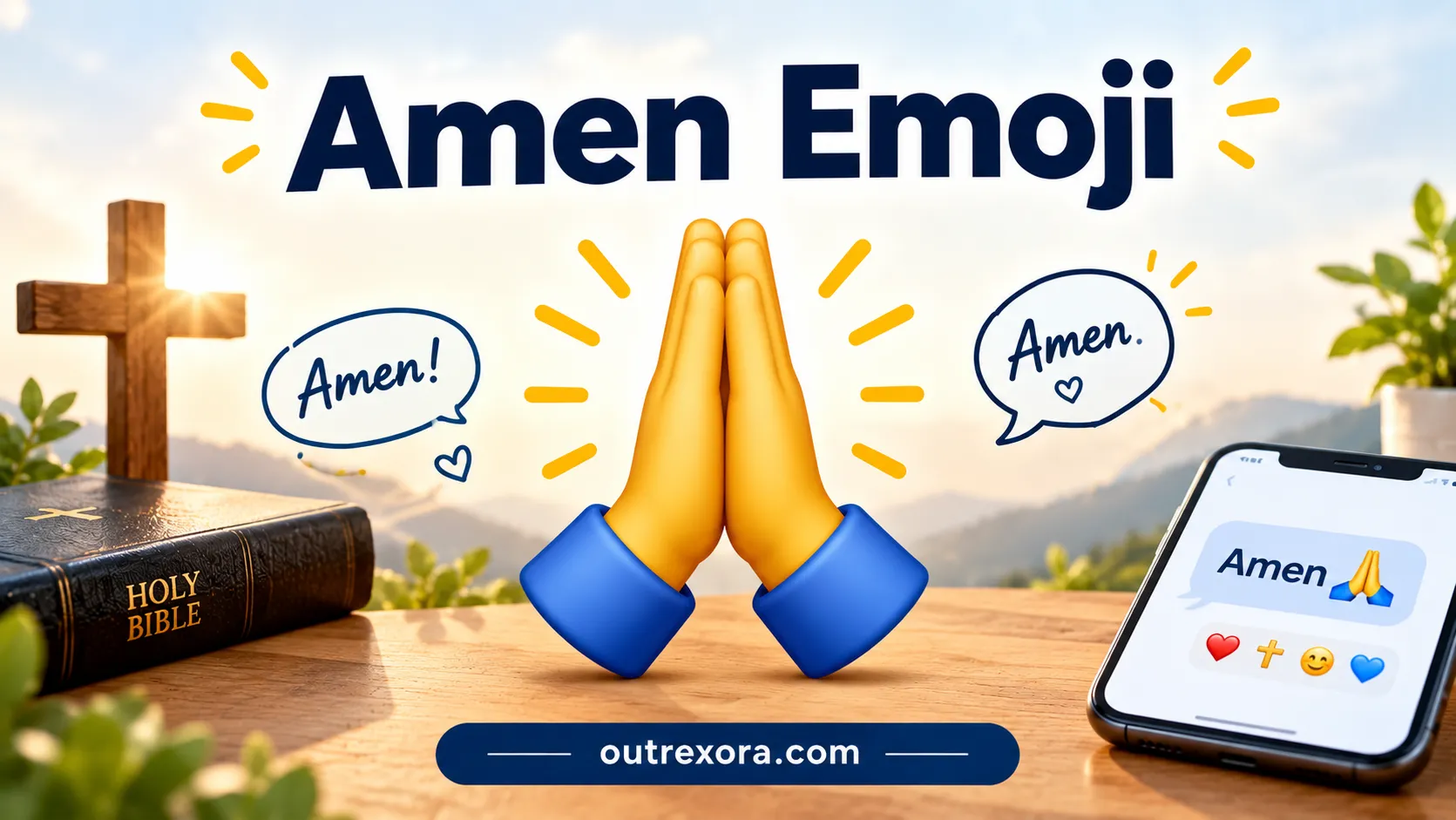
Sometimes a simple prayer emoji can express faith, gratitude, hope, or agreement when words feel too small.
I have often seen people reply to a heartfelt message with the amen emoji instead of writing a long response. It can make a message feel sincere, supportive, and spiritually meaningful.
Depending on the conversation, prayer-related emojis can also appear in greetings, blessings, wishes, and encouraging posts.
From WhatsApp messages to Instagram captions and TikTok comments, context matters. Understanding the common emoji meanings helps you choose the right expression without making your message feel confusing or overly serious.
The amen emoji can turn a simple response into a quiet expression of faith, hope, or heartfelt agreement.
What do amen emoji mean?
The amen emoji is commonly represented by 🙏, especially when someone wants to express prayer, gratitude, hope, blessing. Or agreement with a meaningful statement. Its exact feeling depends heavily on the words surrounding it.
Other closely related prayer and faith emojis can add different tones. For example, 🤲 can accompany a request or heartfelt wish, while 🕊️ can create a peaceful spiritual feeling. Religious symbols such as ✝️, 🛐, and ☦️ may make the message more explicitly faith-related.
| Emoji | Core meaning | Misread as | Best used when |
| 🙏 | Prayer, gratitude, agreement | Thank-you only | Responding to blessings or prayers |
| 🤲 | Open-handed prayer or giving | Asking for something | Sharing hopes, wishes, or prayers |
| 🕊️ | Peace and spiritual hope | Just a bird | Peaceful or faith-based messages |
| ✝️ | Christian faith | Decoration | Christian posts or messages |
| 🛐 | Worship or devotion | Generic symbol | Religious or worship-related contexts |
| ☦️ | Orthodox Christian faith | Decorative cross | Orthodox Christian contexts |
| ❤️ | Love and heartfelt care | Romantic love only | Adding warmth to supportive messages |
| 📿 | Prayer or devotional practice | Jewelry | Faith-related conversations |
| ⛪ | Church or Christian setting | Building icon | Church visits or Christian posts |
| 🕯️ | Remembrance, prayer, reflection | Decoration | Quiet or reflective messages |
Meaning & Example
🙏 Prayer Hands
Meaning: Prayer, gratitude, hope, or heartfelt agreement.
Example 1: Amen to that 🙏
Example 2: May everything work out 🙏
🤲 Open Hands
Meaning: An open gesture often used with prayers, wishes. Or heartfelt requests.
Example 1: Praying for good news 🤲
Example 2: May your wish come true 🤲
🕊️ Dove
Meaning: A peaceful spiritual symbol often paired with messages about hope or peace.
Example 1: Wishing you peace 🕊️
Example 2: Keep faith and hope 🕊️
✝️ Latin Cross
Meaning: A Christian religious symbol used in explicitly Christian contexts.
Example 1: God bless you ✝️
Example 2: Faith gives me strength ✝️
🛐 Place of Worship
Meaning: Religious devotion, worship. Or spiritual reflection.
Example 1: Time to pray 🛐
Example 2: A peaceful moment of worship 🛐
☦️ Orthodox Cross
Meaning: A symbol associated with Eastern Orthodox Christianity.
Example 1: Keeping faith close ☦️
Example 2: A blessed Sunday ☦️
❤️ Red Heart
Meaning: Warmth, love, care, or heartfelt emotion.
Example 1: Sending love ❤️
Example 2: Thank you for your prayers ❤️
📿 Prayer Beads
Meaning: A devotional or prayer-related symbol connected with spiritual practice.
Example 1: A quiet moment of prayer 📿
Example 2: Keeping faith today 📿
⛪ Church
Meaning: A church setting, Christian gathering, or religious occasion.
Example 1: Heading to church ⛪
Example 2: Sunday service today ⛪
🕯️ Candle
Meaning: Reflection, remembrance, prayer. Or a peaceful spiritual moment.
Example 1: Lighting a candle tonight 🕯️
Example 2: Remembering with love 🕯️
How to use amen emoji the right way
On WhatsApp, the amen emoji usually feels personal and emotional. It works naturally after prayers, blessings, good wishes, or encouraging messages. A short reply such as “Amen 🙏” can feel more heartfelt than a plain “okay.”
On Instagram, prayer and faith emojis can become part of captions, inspirational posts, church-related content, or personal reflections. They can also support an aesthetic without overwhelming the caption.
On TikTok, the same symbols can appear in humorous, relatable, or trend-driven comments. Context is especially important because an emoji that looks serious in one video can become playful or ironic in another.
Simple dos and don’ts
Do use 🙏 when someone shares a prayer, blessing, hope, or meaningful wish.
Do combine a short sentence with an emoji when you want your message to feel natural.
Don’t use several religious symbols randomly if the conversation has no faith-related context.
Don’t assume every person interprets prayer-related emojis in exactly the same way.
For example, “Praying for better days 🙏” is straightforward, while “That’s exactly what I needed to hear 🙏❤️” adds a warmer personal touch.
Best amen emoji combos copy & paste
Romantic
👉 ❤️🙏 Sending love and prayers for us.
👉 ❤️🕊️ Wishing peace and love together.
👉 ❤️🙏🕯️ A heartfelt prayer with warmth and reflection.
Cute
👉 🙏❤️ A sweet and caring response.
👉 🤲❤️ Sending a heartfelt wish with affection.
👉 🕊️❤️ A gentle message of peace and care.
Flirty
👉 ❤️🙏 Hoping your sweet wish comes true.
👉 🙏❤️🕊️ Sending a warm and playful blessing.
👉 🤲❤️ Making a heartfelt little wish.
Missing someone
👉 🙏❤️ Thinking of you with love.
👉 🕊️❤️🙏 Sending peace and affection from afar.
👉 🕯️❤️ A quiet, heartfelt reminder of someone special.
Good night
👉 🌙🙏 Good night with a peaceful prayer.
👉 ❤️🙏 Sending love before sleep.
👉 🕯️🙏 Ending the day with a quiet moment of reflection.
Trending amen emoji in 2026
In 2026, prayer and faith-related emojis continue to fit naturally into short-form conversations where people want to communicate emotion without writing a long explanation. Their use can vary between sincere spiritual posts, supportive replies, inspirational content, and playful social-media interactions.
🙏 remains especially recognizable because it can fit naturally into everyday messages as well as faith-focused conversations. 🕊️ and ❤️ can complement peaceful or supportive content, while ✝️ is more direct when a Christian context is intended.
Content creators may use these symbols in captions, comments, video overlays, and community posts. On WhatsApp, they often feel more personal, while Instagram and TikTok can give them a more visual or trend-aware role.
| Emoji | Why trending | Who uses it | Platform |
| 🙏 | Short, recognizable, emotionally flexible | Everyday users, creators | WhatsApp, Instagram, TikTok |
| 🕊️ | Fits peaceful and inspirational content | Creators, faith communities | Instagram, TikTok |
| ❤️ | Adds warmth to supportive messages | Broad social audiences | WhatsApp, Instagram |
| ✝️ | Clearly communicates Christian context | Christian communities, creators | Instagram, TikTok |
As digital communication evolves, emoji combinations generally give people more ways to express tone alongside words.
How to Reply When Someone Sends You the Amen Emoji
The amen emoji usually arrives with real feeling behind it, so a thoughtful reply matters more than a fast one. Read the message around it, respect what the sender is expressing, and answer in the same spirit.
Keep it simple and sincere: a short, kind sentence is almost always the right response. Sincerity reads well in every culture and on every platform.
Mirror their words: if the sender paired the emoji with a greeting, a prayer. Or a short kind message, answering with a similar greeting or wish in return is both polite and welcome.
Do not joke about it: even when your own chats are playful, symbols tied to faith, pride, memory. Or identity deserve a respectful tone. Save the humor for topics where everyone is laughing.
When you are unsure: a warm, neutral reply is never wrong. Thank the sender, wish them well, and let them lead from there.
FAQs:
1. What is the most popular amen emoji?
🙏 is the most commonly recognized emoji for an “amen” response. People often use it after prayers, blessings, good wishes, or statements they strongly agree with.
2. What does 🙏 mean from a girl or boy?
Its basic meaning does not change based on whether the sender is a girl or boy. The surrounding message determines whether it feels like prayer, gratitude, support, or agreement.
3. Why do emojis look different on iPhone vs Android?
Apple, Google, and other platforms create their own emoji artwork from the same Unicode standard. As a result, the design, facial details, colors, and shapes can vary between devices.
4. Are amen emoji used differently in other countries?
Yes. Religious customs, communication styles, and local online culture can influence how prayer-related emojis are understood. Context is important when messaging people from different backgrounds.
Where the Word Amen Comes From
Amen is one of the oldest words still spoken in daily life. It comes from ancient Hebrew, where it means truly, certainly, or so be it. When a prayer ends with amen, the speaker seals it with agreement, saying may it be so.
The word traveled through Christianity, where it closes prayers and hymns, through Judaism, where it answers blessings. And into Islam, where it follows supplications and the recitation of the Fatiha. Hearing the same word in a church, a synagogue, and a mosque is rare in human language. And that shared root is part of why the amen emoji feels universal.
Because the word belongs to living faith traditions, use the emoji with the same respect you would give the word itself. In genuine prayer conversations it is a seal of sincerity, and that is exactly how believers read it.
The Family of Faith Symbols
🙏 rarely travels alone. These companion symbols add shades of meaning to faith conversations. And knowing each one helps you pick the right partner for your message.
| Emoji | Core meaning | Often misread as | Best used when |
|---|---|---|---|
| 🙏 | Prayer, gratitude, heartfelt agreement | Thank you only | Answering blessings or good news |
| 🤲 | Open prayer, wishes, giving | Begging for something | Sharing hopes and heartfelt wishes |
| 🕊️ | Peace and spiritual hope | Just a bird | Peaceful or comforting messages |
| ✝️ | Christian faith | Simple decoration | Explicitly Christian posts |
| 🛐 | Worship and devotion | A generic building | Worship and prayer contexts |
| 📿 | Devotional prayer practice | A fashion necklace | Faith routine conversations |
| ⛪ | Church and Christian gathering | Any old building | Church visits and services |
| 🕯️ | Remembrance and quiet reflection | Room decoration | Memorial or reflective messages |
🙏 Folded Hands
Meaning: Prayer, gratitude, hope, blessing, or heartfelt agreement. The one true amen emoji.
Example 1: Amen to that 🙏
Example 2: Praying everything works out for you 🙏
Unicode fact: Folded hands is Unicode U+1F64F. It was originally designed to show a Japanese gesture of thanks or apology, which is why it also reads perfectly as gratitude and respect worldwide.
🤲 Palms Up Together
Meaning: Open handed prayer, heartfelt wishes, giving, or receiving with humility.
Example 1: Praying for good news this week 🤲
Example 2: May your wish come true 🤲
🛐 Place of Worship
Meaning: Religious devotion, worship, or a sacred space.
Example 1: Heading to evening prayer 🛐
Example 2: A quiet moment of worship 🛐
Prayer or High Five: The Honest Answer
The 🙏 high five debate is one of the longest running arguments in emoji culture. Because the design is ambiguous, a meaningful share of users read it as two hands slapping together in celebration. And some even use it that way in victory messages like We aced that 🙏.
The design history settles it. The emoji was created as folded hands for prayer and thanks, and that is how the Unicode standard defines it. Most of the world reads it as prayer or gratitude. The high five reading is local and playful, never the default in a faith conversation.
Platform art keeps the debate alive. Apple draws detailed praying hands with visible sleeves, which reads clearly as prayer, while Google draws a simpler pair that some mistake for a high five. When your message is truly about prayer, adding the word amen removes all doubt.
When to Avoid the Amen Emoji
A powerful symbol used carelessly loses its power. Skip 🙏 in these situations:
As sarcasm in serious faith chats: A joking 🙏 in the middle of someone’s real prayer reads as mocking. And people remember it.
As decoration on unrelated posts: Stacking prayer symbols on a random selfie for style points cheapens the symbol for everyone.
In the thoughts and prayers flood: After a tragedy, a lone 🙏 with no sentence can feel like noise. One honest line of care says more than a wall of folded hands.
When you mean a literal high five: If celebration is the message, pick 🙌 or 🎉 so nobody reads prayer into your party.
How to Use the Amen Emoji on Different Apps
Amen Emoji on iPhone vs Android
The 🙏 folded hands look different enough across platforms to cause real confusion. On iPhone, Apple draws two hands pressed together with visible sleeves, clearly a prayer or thanks gesture. On Android, Google’s version is a simpler, more stylized pair of hands that some people mistake for a high five.
The emoji also supports skin tone modifiers, so you can send 🙏🏽 or 🙏🏿 to match your own hands. The meaning stays the same, but the personal touch makes gratitude messages feel more human.
Both platforms follow the same Unicode standard, yet each vendor’s art style changes the look. When clarity matters, words plus the emoji always beat the emoji alone.
Trending: Why the Amen Emoji Keeps Growing
In 2026, 🙏 remains one of the most used emojis on earth. And searches for amen emoji copy and paste keep it in the spotlight. Its power is flexibility: the same symbol serves deep faith, casual thanks, hopeful wishes, and respectful greetings.
Culture keeps adding layers. In South Asia the gesture reads as namaste, the anjali mudra greeting of respect. In Japan it accompanies itadakimasu before meals and polite requests. In the West it reads as prayer first. One codepoint, three cultural worlds, and the sender’s background decides which one you are seeing.
Usage history tells the same story of growth. 🙏 spiked sharply during the pandemic as people thanked health workers and sent prayers across locked down cities. 🤲 grows as the softer alternative for wishes, while 🕊️ anchors the peace and remembrance aesthetic on Instagram.
Amen Emoji in Morning Blessings and Daily Good Wishes
Morning blessings have a quiet power, because they set the tone for the whole day ahead. A short good wish in the morning can feel like a gentle prayer for safety, success, and peace. Keep the words simple and warm, and let the wish focus on the person receiving it, not on a long list of hopes.
Good morning, may your day be calm, bright, and full of small blessings.
Wishing you a peaceful morning and a day that brings you good news.
May today treat you kindly, and may every step you take feel light and safe.
Good morning, I pray your work goes well and your heart stays hopeful today.
A new day, a fresh start, and my best wishes for you and your family.
Amen Emoji in Condolence and Encouragement Messages
In hard moments, a short message of faith can offer comfort without saying too much. Condolence and encouragement messages work best when they are gentle, honest, and focused on the person who is hurting. A simple prayer or a kind wish shows that you care, and it leaves room for the other person to reply in their own time.
I am praying for you and your family, and I hope you find strength in the days ahead.
May you find peace and comfort, and may kind memories bring you gentle strength.
You are in my thoughts and prayers, I am here whenever you need a listening ear.
Stay strong, better days will come, and I will keep you in my prayers.
Sending you hope and courage today, may your heart feel a little lighter soon.
Amen Emoji in Morning Blessings and Prayers
Morning blessings with the amen emoji feel warm and hopeful, and a short prayer message can set a kind tone for the day. Use these in family groups and morning wishes.
- Amen to a peaceful morning and a kind day for everyone here.
- Good morning, amen, may today bring health and gentle news.
- Amen, may your prayers today find open doors and kind answers.
- Sending amen with love for a calm heart and a steady day.
- Amen to new beginnings, fresh courage, and small daily joys.
- Morning amen for family near and far, kept safe and well.
Pair the amen emoji with one specific wish, such as health or safe travel, so the message feels personal rather than copied.
Amen Emoji in Condolence and Support Messages
Condolence messages need words that comfort without intruding, and the amen emoji can add quiet solidarity. Keep the message short and let the family lead the conversation.
- Amen, thinking of you and your family in this hard time.
- Sending love and amen, here for you whenever you need to talk.
- Amen, may peace and strength surround you today.
- With amen and prayers for comfort and patience in grief.
- Amen, your loved one will be remembered with respect and love.
- Holding you in prayer, amen, today and in the days ahead.
In grief messages, send one short note and wait, because repeated messages can feel heavy when a family needs space.
Amen Emoji in Gratitude Journals and Thankful Posts
A gratitude journal becomes easier to keep when a small symbol marks each thankful moment, and the folded hands have become a favourite for that job. A short nightly note such as grateful for a kind neighbour today with this symbol turns an ordinary day into a record of good things. The symbol adds a quiet and reverent feeling, which suits gratitude better than a loud celebration face. Readers who keep this habit often say the journal helps them notice small kindnesses they used to miss, like a shared meal, a helpful message, or a sunny walk.
Thankful posts on social media gain the same warmth when the symbol is paired with a specific detail. A caption that names the person, the help, or the moment feels sincere, while a vague thank you with a row of symbols can feel automatic. A line such as thank you for the lift to the clinic today, I will not forget it tells a real story, and friends who read it often add their own thanks in the comments. That exchange turns a private journal habit into a small circle of gratitude that encourages everyone in it.
Amen Emoji for Sports Wins and Team Prayers
Sports teams use the folded hands before a big match to ask for safety, focus, and fair play, and the symbol has become a compact way to share that moment with supporters. A pre game post with this symbol tells fans that the team is united and hopeful, while a post match message with it thanks supporters for their cheers. The feeling is humble rather than boastful, because the team is asking for blessing rather than claiming a win in advance. Fans respond warmly to that tone, because it shows gratitude for the game itself.
Supporters also use the symbol to celebrate a win without gloating, especially after a close match. A message such as what a game, grateful for this team with folded hands praises the effort on both sides, which keeps rivalries friendly. Coaches who model this tone teach young players that prayer and gratitude belong beside effort and sportsmanship, not instead of them. A team that wins with humility earns respect that lasts far longer than a single score.
Frequently Asked Questions About the Amen Emoji
Can I use the amen emoji if I am not religious? Yes, when the meaning is gratitude or sincere agreement. Many people use it as a warm thank you, and the folded hands read as respectful in most settings.
Does it mean prayer or a high five? It officially means folded hands, so prayer is the main reading. Some platforms draw it in a way that looks like a high five, so read the message first and let the words decide.
Is it suitable for a work message? It suits a sincere thank you or a thoughtful note, but keep it out of formal announcements. One symbol after a kind sentence is enough, and a long row of them can look unprofessional.
Amen Emoji for Exam Success and Good Luck Wishes
Before an exam, an interview, or a driving test, a short amen message can feel like a hand on the shoulder. It says I believe in you and I am hoping for the best, without adding pressure. Students send it in class group chats the night before a big paper, and parents send it to nervous children. The folded hands carry the wish, and the words carry the warmth.
Keep the message short and specific. A line such as amen, may your hard work pay off tomorrow 🙏 feels personal, while a line such as good luck with your interview, amen 🙏 names the moment. Avoid long paragraphs of advice right before the event, because the person needs calm, not more to read. One kind sentence plus the emoji is enough.
After the result arrives, the same emoji works as a thank you. A message such as amen, thank you for your prayers, it went well 🙏 closes the circle and lets everyone who prayed share the joy. If the result was not what was hoped, a gentle amen still offers comfort rather than celebration. The symbol moves easily from hope to thanks to comfort, and that is why it suits good luck messages so well.
Amen Emoji in Birthday Blessings and Celebration Messages
A birthday is a natural place for a blessing, and the amen emoji adds a quiet spiritual touch to the celebration. A message such as happy birthday, amen, may this year bring you health and happiness 🙏 feels warm without sounding formal. It works in family group chats, in a card, or as a reply to a birthday post.
Pair the blessing with one detail from the person’s life. Mention a new job, a new home, or a dream they are chasing, and the wish becomes personal. A line such as amen, may your new home be full of peace and laughter 🙏 says far more than a generic happy birthday with a row of party symbols. The detail shows you were thinking of the person, not only the date.
For milestone birthdays, the amen emoji can sit beside other celebration symbols. A cake, a party popper, and folded hands together say we are celebrating and we are grateful. Keep the prayer part short so the joyful mood stays in front, and let the rest of the message stay light and cheerful.
More Questions About the Amen Emoji
Can I use the amen emoji when I ask others to pray for me? Yes. A short request such as please keep my mother in your prayers, amen 🙏 is clear and respectful, and it invites a kind reply in return.
Is it okay to send the amen emoji to someone of another faith? In most cases yes, because amen is shared across Christianity, Judaism, and Islam, and folded hands read as respect in many cultures. When unsure, add a plain kind sentence so the goodwill stays clear.
How many amen emojis should I send in one message? One is almost always enough. A single folded hands symbol beside a sincere sentence looks calm and genuine, while a long row can look like decoration. Let the words carry the feeling.
Conclusion
The amen emoji is a simple way to add sincerity, faith, gratitude, or support to digital conversations.
If you use it on WhatsApp, Instagram, or TikTok, the surrounding words help make your intention clear.
Choose combinations that naturally match the emotion you want to share, and let the message remain genuine.

I’m Olivia Bennett, a writer at Outrexora.com, where I share clear, engaging, and informative stories about the latest news, insights, and trends.